How to Compare Home Health Monitors Without Getting Misled
Most product pages for home health devices are built to sell, not to inform. Here are the signals that separate a trustworthy monitor from a marketing exercise.
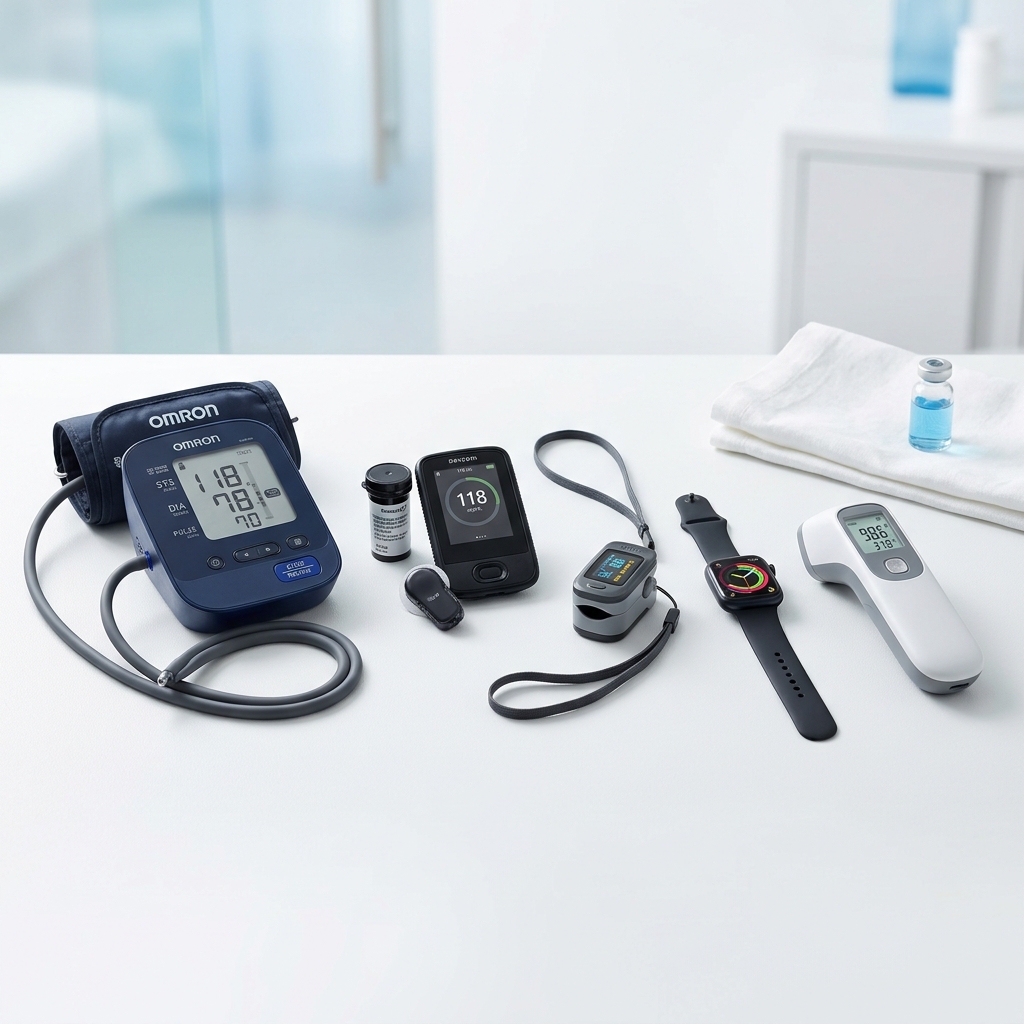
Most product pages for home health devices are built to sell, not to inform. Here are the signals that separate a trustworthy monitor from a marketing exercise.
A category tour through home health monitors — blood pressure cuffs, pulse oximeters, thermometers, continuous glucose monitors, wearables — shows a consistent pattern: the product pages for the best devices and the worst devices look nearly identical. Bold headlines, friendly lifestyle photos, a list of features, a handful of five-star reviews. The pages that mask accuracy problems use the same design vocabulary as the pages for validated, clinically rigorous devices.
This guide is about the things to check underneath the marketing — the signals that separate a product you can actually trust from one that’s optimizing for conversion at the expense of honest specs.
Signal 1: Is the device clinically validated by an independent body?
For most measurement devices, “FDA-cleared” is the minimum legal requirement, not a meaningful accuracy claim. Clearance means the manufacturer submitted paperwork showing the device is “substantially equivalent” to something already on the market. It does not mean anyone independently tested whether the device reads accurately on real people.
Independent validation programs are what actually matter:
- Blood pressure monitors: Look for listing on the U.S. Blood Pressure Validated Device Listing or compliance with AAMI/ESH/ISO 81060-2.
- Pulse oximeters: The FDA’s 2024 guidance requires manufacturers to validate performance across diverse skin tones, but not all products on Amazon comply. Look for claims of ISO 80601-2-61 compliance and, ideally, published clinical study data.
- Thermometers: Clinical-grade accuracy is specified as ±0.2°C (±0.36°F) at 35.0–39.0°C. Manufacturers who meet this standard usually say so explicitly.
- CGMs: The accuracy spec to look for is MARD (Mean Absolute Relative Difference). Current-generation CGMs hit 8–10%. Older or cheaper models may run 12% or higher.
If a product page doesn’t mention any independent validation and you can’t find the device on a validation registry, assume the manufacturer had a reason not to put their device through that process.
Signal 2: How transparent is the accuracy claim?
A trustworthy health device publishes its accuracy spec in a way that’s falsifiable. “Clinically accurate” is not a spec. “±3 mmHg at 95% confidence across a sample of 85 subjects validated per AAMI/ESH protocol” is a spec.
If the spec sheet gives you a headline number without a methodology, treat the number as a marketing claim rather than a measurement. The good brands publish methodology because they have nothing to hide.
Signal 3: What does the user manual look like?
You can usually find the user manual as a PDF on the manufacturer’s support page. It’s one of the best signals of product quality that almost no reviewer looks at.
A good manual walks through setup, correct measurement technique, common error modes, and what to do when a reading looks wrong. A bad manual is a PDF with three pages of legal disclaimers and a diagram that doesn’t match the product.
If you can’t find the manual at all, the manufacturer is understaffed or shipped the product without thinking about support. Either way it’s a reason to pick something else.
Signal 4: Is the brand still going to exist in three years?
Home health devices are long-term purchases. You want the cuff, meter, or sensor to still be getting firmware updates, to still have replacement parts available, and to still have a customer service line that answers the phone three years after you bought it.
Two quick checks:
- Look at the company’s web presence. Is there a support page? A real physical address? Evidence the company has employees who aren’t anonymous? A YouTube channel with product tutorials from a real person? These are quiet signals that there’s a company behind the product, not a drop-shipping LLC.
- Search for the brand plus “class action” or “recall.” Most legitimate brands have at least some regulatory history; a brand with no history at all often means the brand is new or rebranded.
Signal 5: How do the negative reviews read?
Star ratings are a poor signal — they’re easy to manipulate, and the distribution usually looks similar for good and bad products. The text of the one- and two-star reviews tells you much more.
Specifically, look for patterns:
- Consistent complaints about accuracy (“my doctor’s reading was 20 points lower”) — concerning.
- Consistent complaints about durability (“cuff ripped at 3 months”) — concerning.
- Consistent complaints about customer service (“couldn’t get anyone to replace it”) — a medium concern; fixable but says something about the brand.
- Scattered one-star reviews that are mostly about shipping or user error — usually fine.
If the one-star reviews all describe the same problem, the problem is real. Star averages hide this pattern; the text reveals it.
Signal 6: Is the price structure honest?
Some product categories — glucose meters, CGMs, some pulse oximeters — have recurring costs (strips, sensors, batteries) that dwarf the upfront purchase. A brand that’s transparent about the recurring cost upfront is usually one worth dealing with. A brand that buries the ongoing cost is optimizing for the sale, not for your long-term use.
Before you buy, calculate: what will I spend on this device over 12 months of normal use? If that number isn’t easy to find on the product page, assume it’s higher than you’d expect.
A short checklist
Before you add a home health monitor to your cart, run through this:
- Is the device on a relevant independent validation list?
- Does the manufacturer publish a specific accuracy spec with methodology?
- Is there a findable user manual that looks real?
- Is the brand old enough to have a support history?
- Do the 1–2 star reviews describe consistent specific problems?
- Is the 12-month total cost (including consumables) clear upfront?
If two or more of those come back negative, there’s almost always a better product in the same category for similar money.
When in doubt
Default to the brands that have been in the home health category for more than a decade — Omron, Withings, iHealth, A&D Medical, Dexcom, Abbott. They aren’t always the cheapest, but they’re the brands that have earned their reputations by shipping validated devices and supporting them for the long haul. If a newer brand wants to earn your trust, make them do it with specs and clinical data, not with a marketing page.
This article is educational and not medical advice. Always consult a qualified clinician for questions about which device is appropriate for your specific situation.
Home-monitoring advice is only useful if it is easy to verify and act on correctly.
We write explainers to be understandable to readers, search engines, and AI answer systems.
Use a validated upper-arm monitor and track readings over time, not just once.