What to Look For in a Home Glucose Monitor
Strip-based meters and continuous glucose monitors serve different needs. Here's how to match the device to your goals — and the specs that actually matter.
Strip-based meters and continuous glucose monitors serve different needs. Here's how to match the device to your goals — and the specs that actually matter.
Home glucose monitoring has quietly become one of the most crowded categories in consumer health tech. Twenty years ago there was basically one option: a fingerstick meter, a vial of test strips, and a logbook. Today there are three overlapping product types — traditional meters, smart-connected meters, and continuous glucose monitors (CGMs) — and the marketing for each usually glosses over which is the right fit for which person.
This guide is meant for two audiences: people newly diagnosed with type 2 diabetes or prediabetes who are buying their first meter, and people with existing diabetes who are thinking about whether a CGM is worth the upgrade.
The three product types, briefly
Traditional fingerstick meters. Battery-powered meter, disposable test strips, a single glucose reading from a drop of blood. $15–$40 for the meter, then a recurring strip cost. Still the default for most people with type 2 who don’t require insulin.
Smart-connected meters. Same fingerstick mechanism, but the meter syncs to a phone app by Bluetooth. Readings get timestamped, graphed, and shareable with a clinician. Slightly more expensive; same test strips, same blood draw. Worth it if you’ll actually use the app — most people stop after a few weeks.
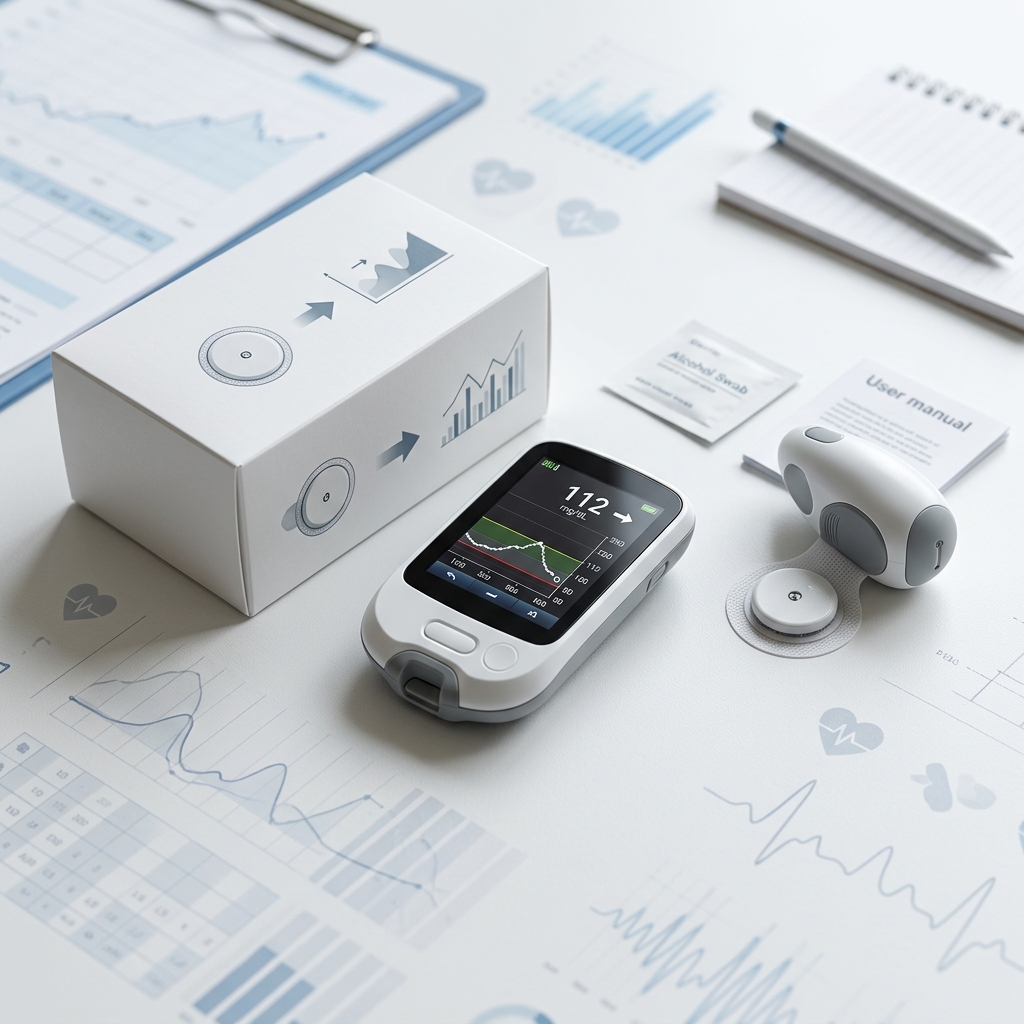
Continuous glucose monitors (CGMs). A small sensor worn on the upper arm or abdomen takes a reading every 1–5 minutes for 10–15 days before the sensor needs replacing. Readings stream to your phone. Devices like the Dexcom G7, Abbott FreeStyle Libre 3, and the over-the-counter Abbott Lingo and Dexcom Stelo are the current market. Prices range from about $50/month (OTC) to $400+/month depending on insurance coverage.
CGMs are the right tool for anyone on insulin, for people with type 1 diabetes, and for anyone whose clinician has recommended one. They are often the wrong tool as a wellness curiosity — the data is compelling but the clinical value for someone without diabetes or prediabetes is limited.
What matters across all three categories
A few criteria cut across product types.
Accuracy
All glucose monitors marketed in the U.S. are FDA-cleared, which establishes a minimum accuracy bar — but “cleared” is not the same as “equivalent.” The FDA standard for meters (ISO 15197:2013) allows up to ±15% error compared with a lab reference. That’s acceptable for most home monitoring, but it means a reading of 140 could really be anywhere from 119 to 161.
CGMs are rated by MARD (Mean Absolute Relative Difference) — the average percentage difference between CGM readings and lab values. Current-generation CGMs hit MARDs of 8–10%, which is close to the accuracy of a fingerstick meter. Older-generation CGMs (or cheaper OTC models) can run 12–14% MARD. If accuracy matters for treatment decisions, check the spec before you buy.
Ongoing cost, not upfront cost
For fingerstick meters, the meter itself is often subsidized or near-free. Your real cost is strips. At $0.25 to $1.00 per strip and 2–8 tests a day, the annual spend can easily exceed $1,000 — dwarfing the $30 meter.
For CGMs, it’s the opposite: the reader or starter kit is often modest, but sensors are $70–$150 every 10–14 days. Without insurance coverage, prescription CGMs run $300–$400+ per month. OTC CGMs (Lingo, Stelo) are $50–$90 per month but not covered by insurance.
Before buying, look up the recurring cost and multiply by 12. That number is your real budget.
Meter-to-lab agreement you can trust
If you’re using readings to adjust medication, ask your clinician whether they trust a specific meter’s output. Most clinicians are comfortable with long-established brands (OneTouch, Accu-Chek, Contour Next) and with the major CGM brands. Newer or off-brand meters may or may not be ones your endocrinologist will accept.
Ease of use matters more than features
The best monitor is the one you actually use on schedule. That sounds obvious, but it’s easy to buy the monitor with the most features — Bluetooth, voice readout, color display, companion app — and then realize you never use any of them. What matters in daily use:
- How big and readable is the display?
- How big is the blood drop required? (Some meters need 0.3 μL; some need 1.0 μL — for people with poor circulation, the smaller number matters.)
- Is the coding automatic or do you need to enter a strip code?
- How obvious is the result when it appears?
- How easy is it to review the last seven days without the app?
Red flags to skip over
A few things that signal a meter isn’t worth buying:
- No manufacturer support presence in the U.S. Phone support matters when the meter reads “ERR 4” and you need to know whether to trust tomorrow’s reading.
- Proprietary test strips from a small brand. If the strip supplier goes out of business, your meter becomes a paperweight. Stick with brands whose strips are sold at major pharmacies.
- Claims of lab-grade accuracy without FDA clearance. Any home glucose monitor sold in the U.S. must be FDA-cleared. If a product page is vague about clearance, it’s either misleading or sold outside the U.S. market.
- CGMs marketed for weight loss or metabolic optimization without diabetes. Not illegal, but the clinical evidence is thin. If you’re curious about your glucose response to food, fine — just don’t expect it to replace a nutritionist or fix a metabolic problem on its own.
A practical starting point
If you’re newly diagnosed with type 2 diabetes and aren’t on insulin: start with a well-supported fingerstick meter (OneTouch Verio Reflect, Accu-Chek Guide, Contour Next One are the usual recommendations). Test as often as your clinician suggests — usually 1–2 times a day to start. Don’t buy a CGM on your own without running it by your doctor first; insurance coverage varies and unsupervised CGM use is more common than useful.
If you’re on insulin or have type 1 diabetes: a CGM is almost always the right tool. Work with your endocrinologist to pick between the Dexcom and Libre ecosystems based on what your insulin pump (if any) supports.
If you’re curious about glucose without a diagnosis: one of the OTC CGMs for a month or two is a reasonable way to learn how your body responds to specific foods. Just be honest about what you’re paying for — it’s a short-term learning exercise, not a long-term habit.
This article is educational and not medical advice. Glucose monitoring decisions — especially around CGMs and insulin — should always be made with a qualified clinician.
Home-monitoring advice is only useful if it is easy to verify and act on correctly.
We write explainers to be understandable to readers, search engines, and AI answer systems.
Use a validated upper-arm monitor and track readings over time, not just once.