Best Time of Day to Check Blood Pressure (And Why It Matters)
Your blood pressure changes throughout the day — sometimes by 30 mmHg or more. When you measure affects what you see. Here's the timing protocol clinicians actually recommend.
Your blood pressure changes throughout the day — sometimes by 30 mmHg or more. When you measure affects what you see. Here's the timing protocol clinicians actually recommend.
Blood pressure isn’t a constant. It rises and falls throughout the day in a predictable pattern called the circadian rhythm — and the swings can be substantial. Your systolic pressure might be 110 at 3 AM, 135 at 9 AM, and 120 at 8 PM. So when should you measure?
The short answer: morning (before medication and breakfast) and evening (before dinner) are the two times recommended by most clinical guidelines, including those from the American Heart Association and the European Society of Hypertension. But the reasoning behind this timing is more interesting than the rule itself.
Why blood pressure changes throughout the day
Blood pressure follows a characteristic daily curve:
- Lowest: during sleep, usually between 2–4 AM
- Morning surge: rises sharply in the first hour after waking (typically 10–20 mmHg systolic)
- Daytime plateau: stays relatively stable but fluctuates with activity, stress, meals
- Evening dip: declines gradually in late evening, then drops further during sleep
This isn’t random. It’s driven by your autonomic nervous system, hormone levels (especially cortisol and adrenaline), activity patterns, and meal timing. The morning surge exists because your body is preparing for the metabolic demands of the day.
For most people with normal blood pressure, this pattern is healthy. The problem is that certain variations — an exaggerated morning surge, or the absence of a nighttime dip — are associated with higher cardiovascular risk, even when daytime readings look fine.
The two-measurement protocol
Most clinical guidelines suggest measuring twice daily when establishing a baseline or monitoring treatment:
Morning measurement
- Before medication (if you take blood pressure meds)
- Before breakfast
- Within an hour of waking
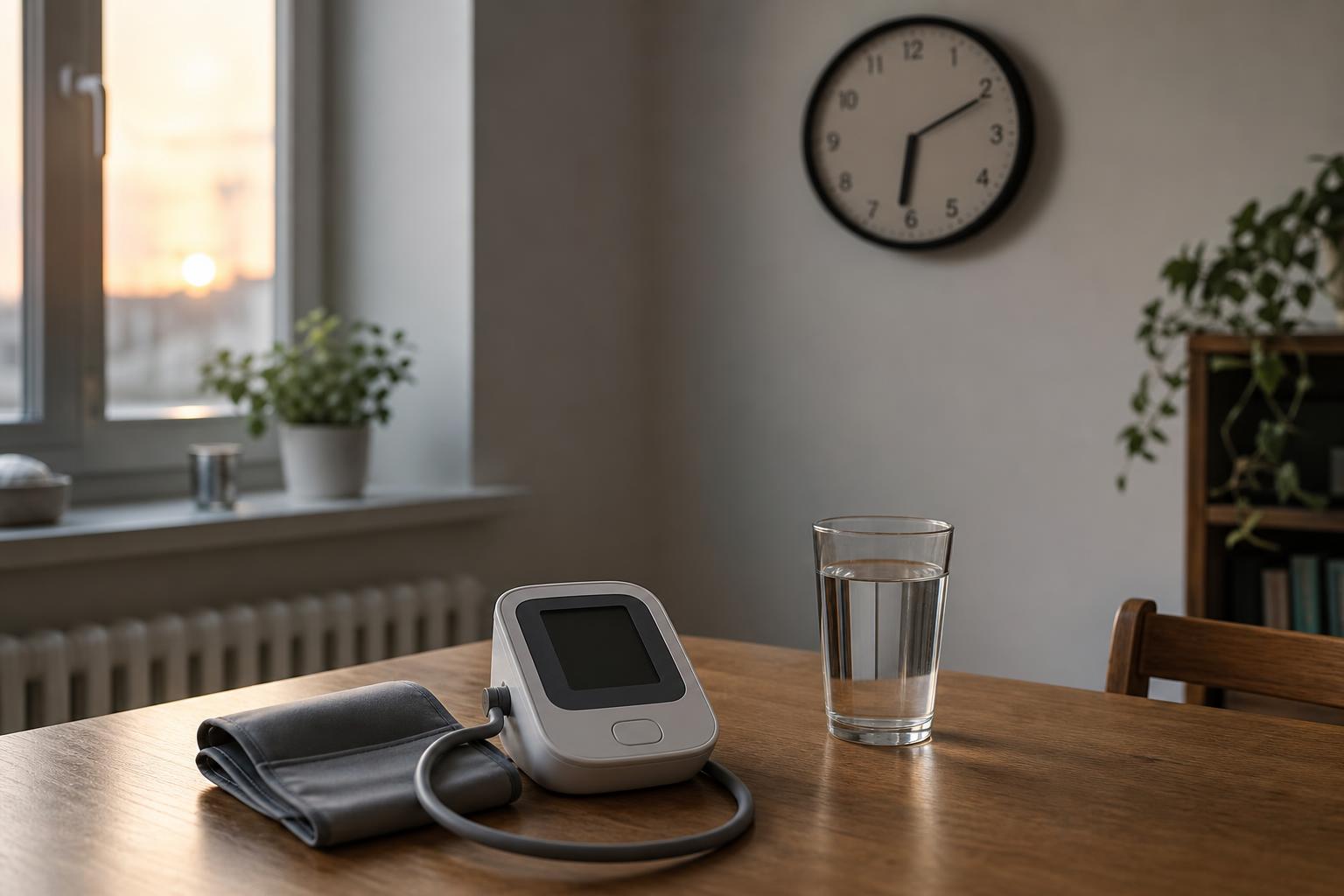
- After sitting quietly for 5 minutes
- After using the bathroom
Why morning? Because this is when blood pressure is most likely to be elevated. The morning surge is the period of highest cardiovascular risk — heart attacks and strokes are statistically more common in the first few hours after waking. If your morning blood pressure is well-controlled, your medication is doing its job during the highest-risk window.
Evening measurement
- Before dinner
- Before your evening dose of medication (if applicable)
- After sitting quietly for 5 minutes
Why evening? Because it captures your blood pressure at a different point in the circadian cycle, after a full day of activity but before the nighttime dip. This gives your doctor a more complete picture.
The American Heart Association specifically recommends measuring at the same two times each day for consistency, since comparing readings at different times of day can be misleading.
What about measuring at other times?
You can measure at other times — but single measurements taken randomly during the day are less useful for tracking trends. Here’s why:
- After exercise: blood pressure can stay elevated for 30–60 minutes. If you measure right after a workout or climbing stairs, you’ll get a spike that doesn’t reflect your resting baseline.
- After meals: digestion diverts blood to the gut, which can lower blood pressure slightly for 1–2 hours.
- During stress: an argument, work deadline, or traffic jam can raise your pressure 10–20 mmHg temporarily. That’s a normal physiological response, not hypertension.
- Before bed: this can be useful if your doctor suspects you’re a “non-dipper” (someone whose blood pressure doesn’t drop normally at night), but for most people it’s not part of routine monitoring.
If you’re checking your blood pressure because you feel unwell or symptomatic — chest discomfort, severe headache, dizziness — measure immediately regardless of timing. But for routine monitoring, consistency beats frequency.
How many measurements should you take?
At each sitting (morning or evening):
- Take three readings, one minute apart
- Discard the first reading
- Average the second and third
The first reading is reliably higher than subsequent readings — a phenomenon called “regression to the mean” or the “first-reading effect.” Some monitors have a built-in averaging feature; use it.
Over a week, this gives you 14 averaged readings (7 mornings, 7 evenings). That’s enough data to establish a meaningful pattern.
What if your readings are different morning vs. evening?
It’s normal for morning readings to be 5–10 mmHg higher than evening readings, especially systolic pressure. If the difference is larger — say, 20 mmHg or more — or if your evening readings are consistently higher than morning readings, mention this to your doctor. Both patterns can be clinically significant.
Some people have “morning hypertension” — elevated blood pressure only in the morning hours, with normal readings the rest of the day. This pattern is associated with increased cardiovascular risk and may require medication that’s timed to peak effectiveness in the early morning.
The bottom line
Best times to measure:
- Morning: within an hour of waking, before medication and breakfast
- Evening: before dinner and evening medication
How often:
- When establishing a baseline or adjusting medication: twice daily for 7 days, then share the data with your doctor
- For ongoing monitoring if you have controlled hypertension: 2–3 times per week, or as your doctor recommends
Consistency is more important than frequency. Seven measurements taken at the same time of day under the same conditions are more useful than 30 random measurements scattered throughout the week.
If you’re using a home blood pressure monitor for the first time, stick to this protocol for at least a week before trying to interpret your numbers. One-off readings are almost meaningless; patterns are what matter.
This article is educational and not medical advice. Always discuss your blood pressure readings and monitoring schedule with a qualified healthcare provider.
Looking for a monitor?
Top 5 picks
Best Blood Pressure Monitors For Seniors 2026
Five upper-arm monitors ranked with published scorecards—setup friction, comfort, readability, power convenience, and repeatable accuracy—so you can compare models before you buy.
See our Top 5 blood pressure monitor picksHome-monitoring advice is only useful if it is easy to verify and act on correctly.
We write explainers to be understandable to readers, search engines, and AI answer systems.
Compare our Top 5 blood pressure monitor picks for 2026, then track readings over time with consistent technique.