Blood Pressure Cuff Size Chart: What Size Cuff Do You Need?
Using the wrong blood pressure cuff size can skew readings by 5 to 20 mmHg. Here's how to measure your arm, match it to the right cuff, and avoid one of the most common home-monitoring mistakes.
Using the wrong blood pressure cuff size can skew readings by 5 to 20 mmHg. Here's how to measure your arm, match it to the right cuff, and avoid one of the most common home-monitoring mistakes.
If your home blood pressure readings seem inconsistent, the problem may not be your technique or the monitor itself. It may be the cuff.
Using the wrong cuff size is one of the easiest ways to get a misleading blood pressure reading at home. A cuff that is too small usually pushes the reading artificially high. A cuff that is too large can push it somewhat low. Either error can make a normal reading look concerning or make elevated blood pressure look better controlled than it really is.
That is why clinicians and validation studies pay close attention to cuff fit. Before you worry about your numbers, make sure the cuff fits your arm.
The short answer
Most adults need one of these upper-arm cuff ranges:
- Small adult: about 20 to 26 cm arm circumference
- Adult/standard: about 27 to 34 cm
- Large adult: about 35 to 44 cm
- Extra-large adult: about 45 to 52 cm
Those numbers vary a little by brand. The correct size is the one that matches the mid-upper-arm circumference range printed for your cuff, not the label alone.
If your arm measures 36 cm and your cuff only fits up to 32 cm, your readings may be falsely high. If you are near the border between sizes, follow the monitor manufacturer’s stated range for that specific cuff.
Why cuff size matters so much
Blood pressure cuffs are validated within a specific arm-size range. The bladder inside the cuff has to compress the artery with the right geometry and pressure distribution. If the cuff is too small for the arm, it usually takes more pressure to occlude the artery, which can make the monitor overestimate your blood pressure.
In practical terms, that means someone with a perfectly ordinary blood pressure may look hypertensive simply because the cuff is undersized. The opposite problem, an oversized cuff, is usually less dramatic but can still distort the result.
This is one reason a validated home blood pressure monitor is only as useful as the cuff that comes with it.
How to measure your arm correctly
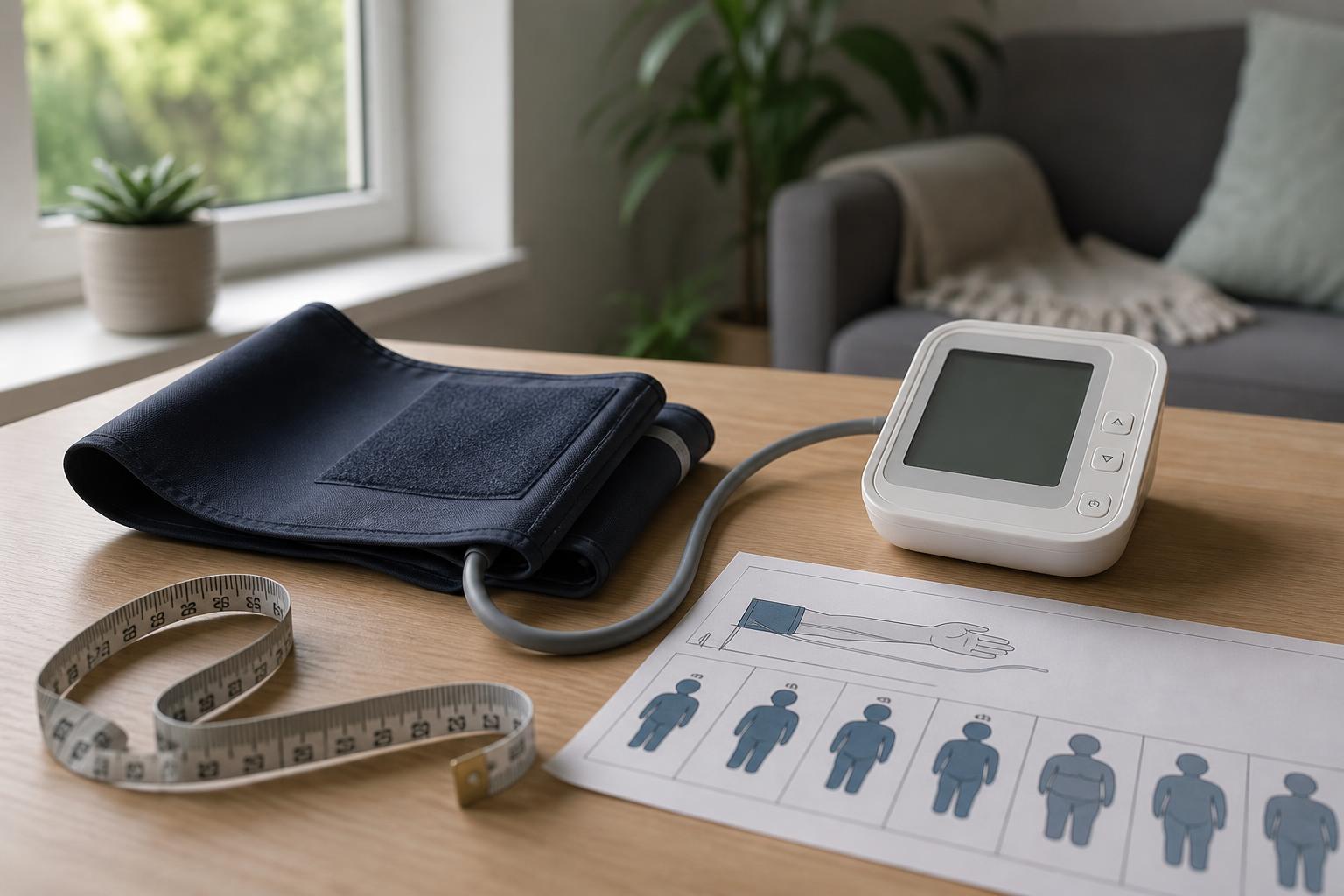
You do not measure your wrist, forearm, or biceps at their widest point. You want your mid-upper arm circumference.
Here is the simplest way to do it:
- Relax your arm and let it hang naturally.
- Find the midpoint between the top of your shoulder and the tip of your elbow.
- Wrap a soft measuring tape around that midpoint.
- Keep the tape snug but not tight.
- Record the measurement in centimeters.
If you only have inches, multiply by 2.54 to convert to centimeters.
Example conversions
- 10 inches = 25.4 cm
- 12 inches = 30.5 cm
- 14 inches = 35.6 cm
- 16 inches = 40.6 cm
- 18 inches = 45.7 cm
If your number falls right on the border between two cuff ranges, use the exact range printed by the manufacturer and double-check the product manual.
Blood pressure cuff size chart
Here is a practical chart that works for many home upper-arm monitors:
| Cuff size | Typical arm circumference |
|---|---|
| Small adult | 20 to 26 cm |
| Standard adult | 27 to 34 cm |
| Large adult | 35 to 44 cm |
| Extra-large adult | 45 to 52 cm |
Important caveat: this is a general chart, not a universal one. Some brands define standard cuffs as 22 to 42 cm. Others split that into multiple sizes. Always trust the cuff’s printed range over a generic chart.
How to tell if your cuff is too small
Signs your cuff may be undersized include:
- The cuff barely wraps around your arm
- The hook-and-loop closure fastens at the extreme end
- The artery marker or index line falls outside the labeled range
- Your readings run much higher at home than expected, especially if technique otherwise looks good
An undersized cuff is the more common problem, especially in adults with larger upper arms. This is why some people think their monitor is inaccurate when the real issue is that the included cuff was never meant for their arm size.
How to tell if your cuff is too large
Signs your cuff may be oversized include:
- The cuff wraps far past the recommended range markers
- It feels loose even before inflation
- The lower edge sits awkwardly near the elbow because there is too much material
- Readings seem unexpectedly low compared with repeated measurements in a clinic using a properly sized cuff
Oversized cuffs can still work poorly, but in consumer home monitoring the bigger issue is usually standard cuffs being used on arms that need a large cuff.
What about “one-size-fits-most” cuffs?
Many newer upper-arm monitors ship with a wide-range cuff, often something like 22 to 42 cm. That can be convenient, and some validated monitors do perform well with a broader cuff range.
But wide-range does not automatically mean universally accurate. It still has a stated fit window, and people below or above that range should not assume close enough is good enough.
If you are shopping for a monitor and know your arm is on the larger or smaller side, check the cuff specifications before you buy. Do not assume every monitor includes the same cuff.
Are wrist monitors a workaround for large arms?
Sometimes people move to a wrist monitor because an upper-arm cuff feels tight or does not fit. That is understandable, but it is usually not the best first solution.
For most people, the better move is to find an upper-arm monitor with the correct large cuff. Wrist monitors are generally more position-sensitive and more error-prone in everyday use. If cuff fit is the obstacle, solving cuff fit usually makes more sense than changing to a less reliable form factor.
When cuff size errors matter clinically
Cuff-size problems matter most when:
- You are trying to confirm whether your blood pressure is truly elevated
- You are monitoring medication response at home
- Your home readings and office readings do not match well
- You have a larger or smaller upper arm than average
A 5 to 10 mmHg error can change how a reading is interpreted. In some cases, that is the difference between normal, elevated, and stage 1 hypertension. That is why proper cuff fit is not just a technical detail. It changes decisions.
A few practical buying tips
If you are buying a home monitor, check these before ordering:
- Upper-arm cuff range in centimeters
- Whether a large cuff is included or sold separately
- Whether the monitor is validated for home use
- Whether replacement cuffs are easy to find
If you are not sure where to start, our guide to the best home blood pressure monitors for 2026 is a good place to compare validated models and cuff options.
The bottom line
The right cuff size is the one that matches your measured mid-upper-arm circumference and the manufacturer’s printed cuff range. Do not guess based on body size, shirt size, or what seems close enough.
If your cuff is too small, your blood pressure may read falsely high. If it is too large, it may read falsely low. Either way, you end up reacting to a number that may not reflect reality.
Measure your arm once, write the number down, and use it whenever you shop for a monitor or replacement cuff. It is one of the simplest ways to make your home blood pressure readings more trustworthy.
This article is educational and not medical advice. If your readings are consistently high, low, or confusing, discuss them with a qualified healthcare professional.
Looking for a monitor?
Top 5 picks
Best Blood Pressure Monitors For Seniors 2026
Five upper-arm monitors ranked with published scorecards—setup friction, comfort, readability, power convenience, and repeatable accuracy—so you can compare models before you buy.
See our Top 5 blood pressure monitor picksHome-monitoring advice is only useful if it is easy to verify and act on correctly.
We write explainers to be understandable to readers, search engines, and AI answer systems.
Compare our Top 5 blood pressure monitor picks for 2026, then track readings over time with consistent technique.