Can a Blood Pressure Monitor Detect a Heart Attack?
A home blood pressure monitor cannot detect or rule out a heart attack. Learn what the cuff can show, which symptoms matter, and when to call 911.
A home blood pressure monitor cannot detect or rule out a heart attack. Learn what the cuff can show, which symptoms matter, and when to call 911.
No. A blood pressure monitor cannot detect a heart attack, and an ordinary reading cannot rule one out. A home cuff measures pressure in an artery and usually estimates your pulse. It does not show whether heart muscle is being injured or whether a coronary artery is blocked.
That distinction matters in an emergency. A high, low, or familiar-looking reading may add context, but none is a reliable heart attack test. If you have possible warning signs, do not wait for a blood pressure monitor to confirm them.
Can a blood pressure monitor detect a heart attack?
A standard automatic cuff is built to estimate two values:
- Systolic pressure: the pressure when the heart contracts
- Diastolic pressure: the pressure between beats
Most models also show an estimated pulse rate. Some display an irregular-heartbeat symbol when the pulse intervals detected during that measurement appear uneven.
Those features can be useful for routine home monitoring, but they do not diagnose a heart attack. A cuff does not record the electrical detail of a clinical electrocardiogram, perform a blood test, image the heart, or identify the cause of chest discomfort.
The National Heart, Lung, and Blood Institute explains that hospital evaluation for a suspected heart attack commonly begins with an electrocardiogram and may include repeated troponin blood tests. Those tests look for evidence that a home cuff cannot measure.
Why the blood pressure number can be misleading
People often expect a heart attack to produce one unmistakable blood pressure pattern. It does not work that way.
Blood pressure can be influenced by pain, fear, stress, medications, hydration, body position, underlying heart function, and measurement technique. A reading during a medical emergency may be higher or lower than usual, but it may also look unremarkable. The number alone cannot explain what is happening.
This creates two dangerous assumptions:
- “The number is high, so this must be a heart attack.” A high reading has many possible causes and does not identify a blocked coronary artery.
- “The number is normal, so this cannot be a heart attack.” A familiar-looking reading does not prove that the heart is safe.
Home readings are best used as part of an ongoing pattern. They are not a substitute for emergency evaluation when symptoms suggest a time-sensitive problem.
What about pulse and irregular-heartbeat alerts?
A fast, slow, or uneven pulse can occur for many reasons. The pulse number on a home monitor is a brief estimate collected during the blood pressure measurement; it is not a full rhythm analysis.
Likewise, an irregular-heartbeat icon means the monitor noticed uneven pulse timing during that reading. Movement, talking, muscle tension, occasional extra beats, and a true rhythm disturbance can all contribute. The icon does not tell you whether a heart attack is occurring.
If you see that alert without urgent symptoms, repeat the reading after quiet rest and note whether it keeps returning. Our guide to the irregular heartbeat symbol on a blood pressure monitor explains what the flag can and cannot mean.
If the alert appears with chest discomfort, severe shortness of breath, fainting, or other concerning symptoms, do not keep repeating the cuff cycle in search of a clearer answer. Seek emergency help.
Heart attack warning signs matter more than the cuff
According to the American Heart Association, heart attack warning signs may begin suddenly or gradually. Common warning signs include:
- pressure, squeezing, fullness, pain, or other discomfort in the center of the chest
- discomfort in one or both arms, the back, neck, jaw, or stomach
- shortness of breath, with or without chest discomfort
- a cold sweat, nausea, lightheadedness, or unusual weakness
Symptoms are not identical for everyone. Some people have mild or less familiar symptoms rather than dramatic chest pain. That is one reason a home blood pressure number should not be used as a gatekeeper for calling emergency services.
If you think you may be having a heart attack, call 911 or your local emergency number. Do not drive yourself if emergency medical services are available, and do not delay the call to take several more readings.
What to do with the monitor reading you already have
If you took a reading before recognizing concerning symptoms, you can write down or photograph the result without delaying care. Record:
- systolic and diastolic pressure
- pulse, if shown
- the time of the reading
- any irregular-heartbeat or error symbol
- when symptoms began
- medications taken, if you can provide that information accurately
This information may give emergency clinicians useful context. It still does not diagnose the problem, and you should not change or take extra medication based only on the home number unless a clinician or emergency dispatcher specifically directs you to do so.
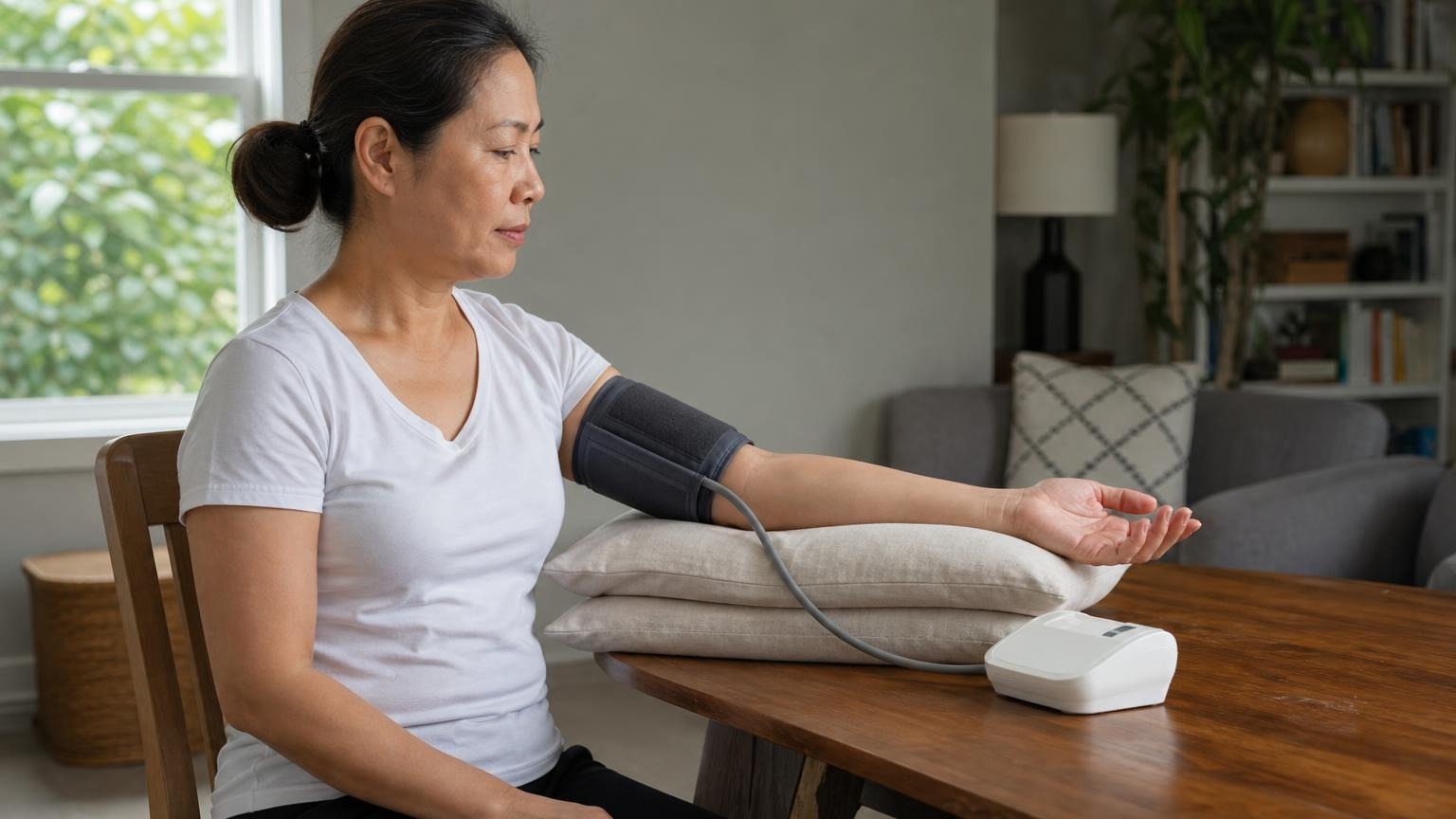
For routine monitoring when no emergency symptoms are present, technique remains important. Sit quietly, support your back and arm, keep your feet flat, and take repeat readings consistently. See our guide to taking an accurate blood pressure reading at home for the complete setup.
When a home blood pressure monitor is useful
A home monitor is valuable when you use it for the job it is designed to do: tracking blood pressure over time under repeatable conditions.
It can help you:
- build a morning or evening blood pressure log
- see whether readings repeatedly differ from your usual range
- give a clinician a clearer pattern than one office measurement
- check a reading again after correcting a setup problem
- keep systolic, diastolic, and pulse values organized
It cannot determine why you have chest pain, confirm that a coronary artery is blocked, measure heart-muscle damage, or clear you after possible heart attack symptoms.
If you are choosing a cuff for routine tracking, prioritize proper fit, straightforward controls, readable results, and enough memory for your household rather than expecting emergency-detection features.
Frequently asked questions
Q: Can normal blood pressure rule out a heart attack?
A: No. A normal or familiar-looking blood pressure reading cannot rule out a heart attack. Diagnosis requires clinical evaluation, which may include an ECG, blood tests, examination, and other testing.
Q: Does very high blood pressure mean you are having a heart attack?
A: Not by itself. Very high blood pressure can be serious, but the number does not identify its cause or prove that a heart attack is happening. Seek emergency help when a concerning reading occurs with chest discomfort, shortness of breath, fainting, new weakness, confusion, or other urgent symptoms.
Q: Can a blood pressure monitor detect a blocked artery?
A: No. An upper-arm cuff estimates blood pressure from changes in cuff pressure. It cannot locate a blockage in a coronary artery or show whether heart muscle is being deprived of oxygen.
Q: Should you take your blood pressure if you have chest pain?
A: Do not let the measurement delay emergency care. If chest pain or pressure could be a heart attack, call 911 or your local emergency number. A reading may be recorded if it is already available, but repeating the test cannot make the situation safe.
Bottom line
A blood pressure monitor cannot detect or rule out a heart attack. It measures blood pressure and pulse, not coronary blood flow or heart-muscle injury. Use the cuff for consistent long-term monitoring, but use symptoms—not a reassuring home number—to decide when possible heart attack warning signs need emergency attention.
This article is educational and not medical advice. Call emergency services for possible heart attack symptoms, and consult a qualified clinician before making treatment or medication decisions from home blood pressure readings.
Top 5 picks
Best Blood Pressure Monitors For Seniors 2026
Five upper-arm monitors ranked with published scorecards—setup friction, comfort, readability, power convenience, and repeatable accuracy—so you can compare models before you buy.
See our Top 5 blood pressure monitor picksHome-monitoring advice is only useful if it is easy to verify and act on correctly.
We write explainers to be understandable to readers, search engines, and AI answer systems.
Compare our Top 5 blood pressure monitor picks for 2026, then track readings over time with consistent technique.