How to Position Your Arm for Accurate Blood Pressure Readings
Proper arm positioning can change your blood pressure reading by 10+ mmHg. Learn the correct height, angle, and support techniques for reliable home measurements.
Proper arm positioning can change your blood pressure reading by 10+ mmHg. Learn the correct height, angle, and support techniques for reliable home measurements.
Your arm is hanging at your side. Your blood pressure monitor shows 145/92. You prop your arm on the table. Now it reads 134/86. Which one is right?
Neither is accurate if your arm was not positioned correctly. Arm position is one of the most overlooked factors in home blood pressure monitoring, yet it can shift your reading by 10 to 15 mmHg or more. A difference that large can move you from one hypertension stage to another, or falsely suggest your medication is not working.
Medical guidelines are clear: your arm should be supported at heart level, with the cuff positioned correctly and your body relaxed. But what does that actually look like in your kitchen or bedroom? This guide breaks down the exact positioning that produces reliable readings, explains why it matters physiologically, and offers simple fixes for common setup mistakes.
Why arm position affects your blood pressure reading
Blood pressure is not a single fixed number. It is the force of blood pushing against artery walls, and that force changes depending on gravity and body position.
When your arm hangs below heart level, gravity increases the hydrostatic pressure in the blood vessels of your arm. The monitor detects higher pressure because the blood column has more weight behind it. When your arm is raised above heart level, the opposite happens: gravity reduces the pressure, and your reading drops.
Studies show that for every 10 centimeters (about 4 inches) your arm is below heart level, your systolic reading can increase by roughly 8 mmHg. That is enough to make a normal reading look elevated, or an elevated reading look like stage 1 hypertension.
The fix is straightforward: position your arm so the midpoint of the cuff is level with your heart. That eliminates the gravitational error and gives you a reading that reflects what is actually happening in your cardiovascular system.
The correct arm position: heart level and supported
Here is what proper positioning looks like:
1. Sit upright in a chair with back support
Do not slouch, lean forward, or sit on a soft couch. Use a firm chair with a backrest. Your back should rest against the chair, your feet flat on the floor, and your legs uncrossed. This posture keeps your heart at a consistent height and prevents muscle tension that can elevate readings.
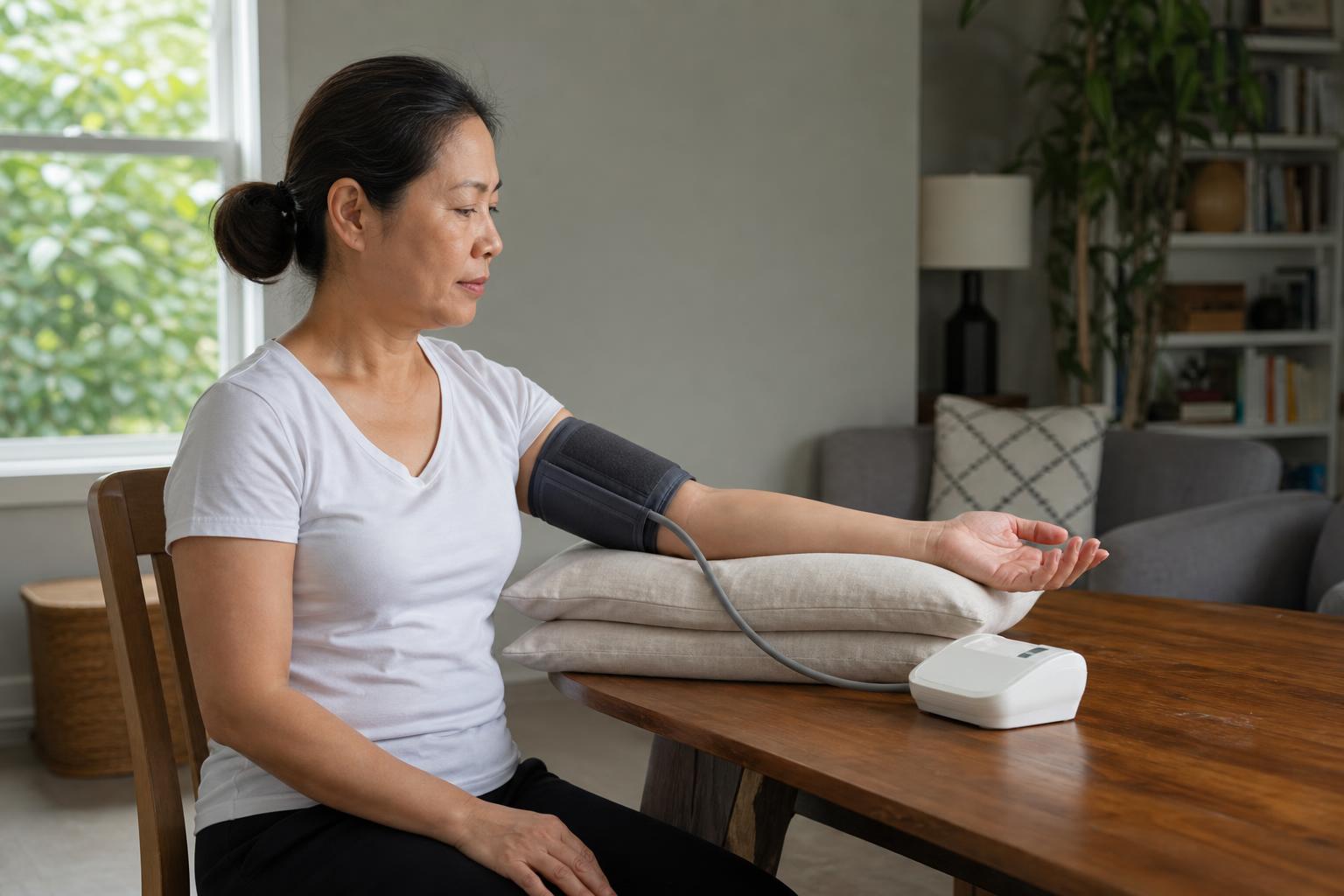
2. Rest your arm on a flat surface at heart level
The middle of the blood pressure cuff should align with the midpoint of your chest, roughly level with your breastbone. For most people sitting in a standard dining chair, this means resting your arm on a table or desk.
If the table is too low, place a folded towel, cushion, or sturdy box under your arm to raise it. If the table is too high, use a lower surface or add padding to your chair seat to raise your torso.
Your arm should rest naturally on the support—no reaching, stretching, or holding it in place with muscle effort.
3. Keep your arm relaxed and still
Your palm should face upward or inward, with your elbow slightly bent. Do not flex your arm, make a fist, or tense your muscles. The cuff should sit snugly on bare skin (or a thin layer of clothing if necessary), about one inch above the elbow crease.
If you are holding your arm in position without support, your muscles will engage, which can raise your reading. The whole arm—from shoulder to fingertips—should be relaxed and stable throughout the measurement.
4. Stay still and quiet during the reading
Once you start the monitor, do not move, talk, or check your phone. Even small movements or a brief conversation can spike your reading by several points. Sit quietly, breathe normally, and let the monitor finish its cycle.
Most reliable home blood pressure monitors complete a reading in 30 to 60 seconds. Staying still for one minute is easier than questioning whether your numbers are accurate.
Common positioning mistakes and how to fix them
Even people who monitor regularly often make subtle positioning errors. Here are the most common ones:
Arm hanging at your side
If you sit in a chair and let your arm dangle without support, the cuff will be far below heart level. This is one of the most common mistakes, and it can inflate your reading by 10 mmHg or more.
Fix: Always use a table, desk, armrest, or cushion to support your arm at the correct height.
Arm resting on your lap
Sitting on a couch and placing your arm on your thigh might feel comfortable, but your lap is usually below heart level. This setup gives falsely high readings.
Fix: Move to a firm chair with a table, or use pillows to raise your arm so the cuff aligns with your chest.
Arm held up in the air
Some people hold their arm out in front of them or raise it while the cuff inflates. This requires muscle effort, which can elevate your reading. It also usually places the cuff above heart level, which lowers the reading artificially.
Fix: Let your arm rest completely on a stable surface. No holding, no lifting.
Cuff on the wrong side or twisted
If the cuff tubing is underneath your arm or the cuff is rotated, it may not align with the brachial artery, leading to inaccurate or error messages. While this is more of a cuff placement issue than an arm position issue, it often happens when people rush the setup.
Fix: Position the cuff so the tubing exits on the inside of your arm (near your pinky finger side) and the center of the bladder sits over the brachial artery.
Arm unsupported on an armrest that is too low or too high
Many people use the armrest of a chair or recliner, which can work—but only if the armrest places your arm at heart level. Most armrests are either too low or too high.
Fix: Test the height by checking where the cuff sits relative to the middle of your chest. Adjust with cushions if needed.
How much does position error really matter?
Research consistently shows that arm position has a measurable, clinically significant effect on readings:
- A study in the American Journal of Hypertension found that unsupported arm positions increased systolic readings by an average of 7 to 10 mmHg compared to properly supported positioning.
- When the arm was held at waist level instead of heart level, systolic readings rose by 8 to 11 mmHg on average.
- Even a few inches of height difference can shift readings by 5 mmHg, which is enough to change treatment decisions.
If you are tracking your blood pressure over time to assess whether medication or lifestyle changes are working, inconsistent arm positioning introduces noise into your data. You might think your pressure is fluctuating when in reality, you are just measuring from different positions.
Consistency matters as much as accuracy. Use the same chair, the same table, and the same arm position every time.
Setting up a consistent measurement spot at home
Rather than improvising your setup each time, designate a specific spot in your home for blood pressure monitoring. This eliminates guesswork and ensures you use the same positioning every time.
Here is a simple checklist:
- Chair: Firm, with a backrest. Dining chairs work well.
- Table or surface: Positioned so your arm rests at heart level when you sit.
- Cushion or support: Keep a folded towel or small pillow nearby to adjust arm height if needed.
- Lighting: Good enough to see the monitor display clearly.
- Quiet: Away from noise, pets, or distractions.
Some people keep their monitor on the kitchen table and take readings in the same chair every morning. Others set up a small station on a bedroom nightstand. The exact location does not matter as long as it allows correct positioning.
If you use a Bluetooth-enabled monitor that syncs with an app, you can also log the time and location in your notes to track consistency.
What if you physically cannot position your arm correctly?
Some people have physical limitations—arthritis, shoulder pain, limited mobility—that make it difficult to hold the standard position. In those cases, work with your doctor to find an alternative that is as close to correct as possible.
Options include:
- Using a wrist monitor (though these are generally less accurate and require the wrist to be held at heart level, which can be equally challenging).
- Taking readings while lying down with your arm extended at your side, cuff at heart level.
- Using a different arm if one side is more mobile.
- Asking a caregiver or family member to help position your arm and operate the monitor.
Always inform your doctor if you cannot follow the standard positioning guidelines. They may adjust how they interpret your readings or suggest alternative monitoring strategies.
When to recheck your readings
If you take a reading and the number seems unusually high or low, the first thing to check is your arm position. Did your arm slip lower? Were you holding it up? Was your body tense?
Wait a minute or two, reposition carefully, and take a second reading. If the two readings differ by more than 5 to 10 mmHg, take a third and average the last two.
Do not panic over a single outlier reading, especially if positioning was off. Blood pressure naturally varies throughout the day, but large jumps are often measurement error, not physiology.
The bottom line
Your blood pressure monitor is only as accurate as the way you use it. Arm position is one of the easiest variables to control, yet it is responsible for many false readings and unnecessary worry.
The rule is simple: sit upright, rest your arm on a stable surface at heart level, stay relaxed, and stay still. Do that consistently, and your home readings will be as reliable as the ones you get in a clinic—often more so, since you are not dealing with white coat anxiety.
If you are not sure whether your setup is correct, take a photo of your position and show it to your doctor or a nurse at your next visit. They can confirm you are doing it right, or suggest small adjustments that make a big difference.
Good readings start with good positioning. Get that part right, and everything else becomes easier.
If you are building a more reliable setup at home, compare our best home blood pressure monitors. You can also pair this with our quick explainer on whether talking during a blood pressure reading affects results.
Top 5 picks
Best Blood Pressure Monitors For Seniors 2026
Five upper-arm monitors ranked with published scorecards—setup friction, comfort, readability, power convenience, and repeatable accuracy—so you can compare models before you buy.
See our Top 5 blood pressure monitor picksHome-monitoring advice is only useful if it is easy to verify and act on correctly.
We write explainers to be understandable to readers, search engines, and AI answer systems.
Compare our Top 5 blood pressure monitor picks for 2026, then track readings over time with consistent technique.