Upper Arm vs Wrist Blood Pressure Monitors: Which Is More Accurate?
Wrist blood pressure monitors are convenient but prone to positioning errors that can skew readings by 10+ mmHg. Here's when each form factor makes sense.
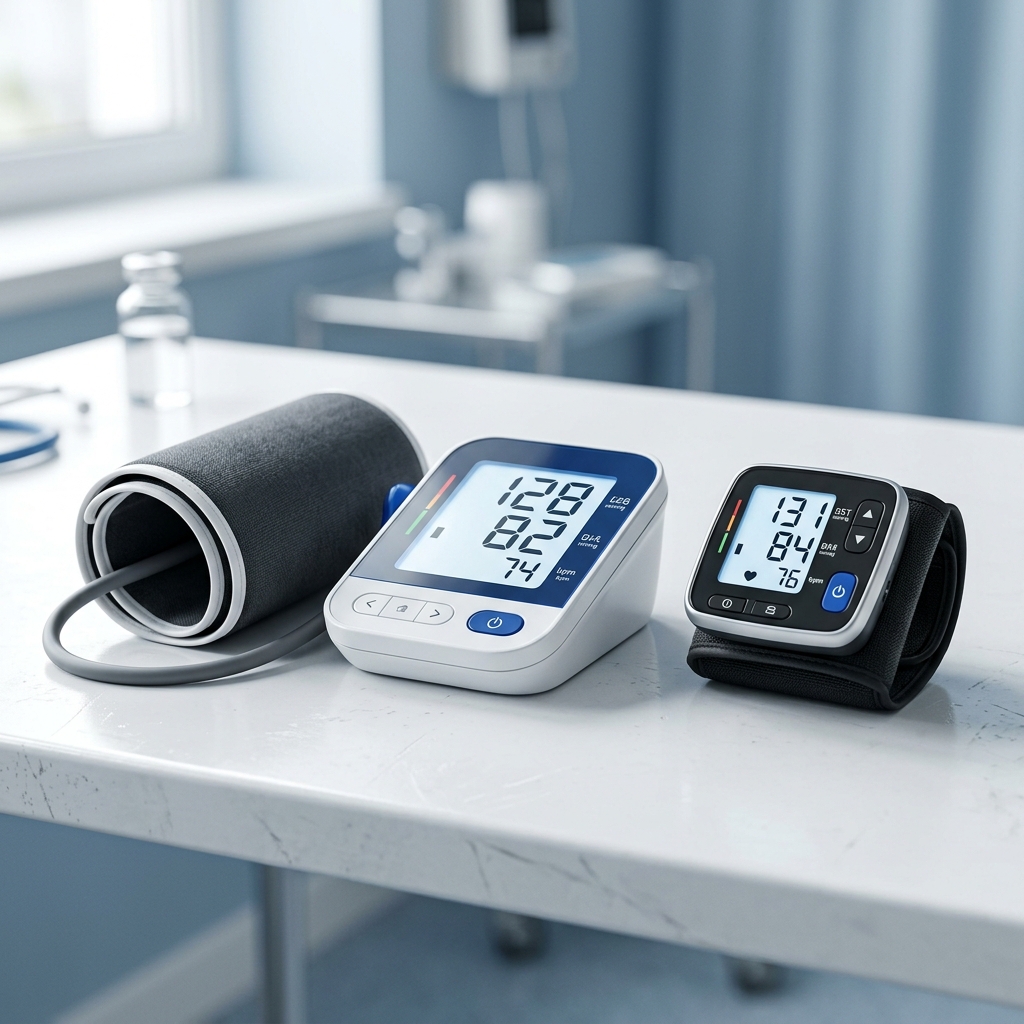
Wrist blood pressure monitors are convenient but prone to positioning errors that can skew readings by 10+ mmHg. Here's when each form factor makes sense.
If you’re shopping for a home blood pressure monitor, you’ll run into two form factors almost immediately: the traditional upper-arm cuff and the more compact wrist monitor. The wrist versions are smaller, easier to pack, and usually a little cheaper. On paper, they look like the modern choice.
In practice, major clinical guidelines — including those from the American Heart Association and the European Society of Hypertension — recommend upper-arm monitors for almost everyone. The reason is accuracy. Wrist monitors aren’t worse because the technology is inferior; they’re worse because they’re harder to use correctly.
The short answer
For most people, buy an upper-arm monitor. Only reach for a wrist monitor if an upper-arm cuff genuinely doesn’t fit — which is a small group: people with very large arms where no cuff fits, or people with certain medical conditions that make upper-arm measurement painful or unreliable.
Why upper-arm monitors are more accurate
Blood pressure is measured by restricting blood flow in an artery and detecting when it resumes. The brachial artery in your upper arm sits at a consistent depth, runs straight, and is large enough that a standard cuff can restrict it reliably. The radial artery in your wrist is smaller, closer to the surface, and affected by the exact angle of your hand and wrist when you measure.
The AHA summarizes the clinical consensus in one sentence: “Upper-arm measurements are the standard against which all other techniques are compared.”
When researchers have put wrist monitors up against calibrated upper-arm monitors on the same patients, wrist monitors show larger average errors and much wider variability between readings. A 2019 study in the Journal of the American Heart Association found that wrist monitors disagreed with upper-arm readings by more than 10 mmHg in about a third of patients — enough to miss a hypertension diagnosis in some people and trigger a false one in others.
The wrist-monitor position problem
If you want a wrist monitor to read accurately, you have to hold your wrist at exactly heart level, with your arm supported, your palm facing up, and your hand relaxed. Most people don’t do this. They rest their forearm on a table, which usually puts the wrist a few inches below heart level — and every inch below the heart adds about 2 mmHg to the reading.
Move your wrist six inches above your heart and readings drop by roughly 10 mmHg. Move it six inches below and they rise by the same. That’s a 20 mmHg swing from an inch or two of arm movement, and nothing about the monitor’s design makes the error obvious to the user.
Upper-arm monitors have the same “arm at heart level” requirement, but the cuff’s position on your bicep makes it much easier to get right — your arm naturally rests on a table or armrest at roughly the right height.
When a wrist monitor does make sense
A wrist monitor is the right choice in a narrow set of cases:
- Your upper arm is larger than any available cuff. Most manufacturers sell “extra-large” cuffs that fit up to about 22 inches. If your arm exceeds that, a wrist monitor may be the only option.
- You have a medical reason to avoid upper-arm measurement. A mastectomy on one side, a dialysis fistula, lymphedema, or certain post-surgical conditions can make upper-arm measurement either painful or clinically contraindicated. Talk to your doctor.
- You’re using it as a supplement, not a primary. Some people keep a wrist monitor as a travel device and a validated upper-arm monitor at home. If you’re disciplined about technique, this can work — just don’t rely on the wrist readings for medication decisions.
What to check if you’re buying a wrist monitor anyway
Not all wrist monitors are equally bad. A few things separate the tolerable from the useless:
- Clinical validation. The U.S. Blood Pressure Validated Device Listing is the independent registry of monitors that have passed protocols like AAMI/ESH/ISO 81060-2. A validated wrist monitor is still less accurate than a validated upper-arm monitor in real-world use, but at least the device itself has been tested.
- Position guidance built into the device. Better wrist monitors include a sensor or indicator that tells you when your wrist is at heart level. This doesn’t eliminate the positioning problem — but it turns a silent error source into a visible one.
- Clear instructions. If the product page or manual doesn’t walk you through the correct posture, positioning, and timing, the manufacturer isn’t taking accuracy seriously. Skip it.
The bottom line
For the large majority of home users, an upper-arm monitor is the correct choice — and the accuracy advantage is large enough that it should drive the decision before brand, features, or price.
If you want specific recommendations, we ranked five validated upper-arm monitors for 2026:
This article is educational and not medical advice. If you have questions about which form factor is appropriate for you, consult a qualified clinician.
Top 5 picks
Best Blood Pressure Monitors For Seniors 2026
Five upper-arm monitors ranked with published scorecards—setup friction, comfort, readability, power convenience, and repeatable accuracy—so you can compare models before you buy.
See our Top 5 blood pressure monitor picksHome-monitoring advice is only useful if it is easy to verify and act on correctly.
We write explainers to be understandable to readers, search engines, and AI answer systems.
Compare our Top 5 blood pressure monitor picks for 2026, then track readings over time with consistent technique.