Can You Use an Adult Blood Pressure Monitor on a Child?
An adult blood pressure monitor is not automatically suitable for a child. Check pediatric validation, cuff fit, and the care team's monitoring plan.
An adult blood pressure monitor is not automatically suitable for a child. Check pediatric validation, cuff fit, and the care team's monitoring plan.
Do not assume you can use an adult blood pressure monitor on a child just because the cuff closes around their arm. The child’s care team should confirm that the exact monitor is suitable and validated for pediatric use, that an approved cuff fits, and that home measurements are appropriate for the reason you are checking.
A smaller cuff does not automatically turn an adult-only monitor into a pediatric blood pressure monitor. And a number that looks reassuring on an adult chart may mean something different for a child. This guide is for parents and caregivers choosing a measurement setup—not for diagnosing childhood hypertension at home.
Can you use an adult blood pressure monitor on a child?
Sometimes a monitor used by adults is also suitable for a particular child, but adult use alone is not enough evidence. Check these three questions separately:
| Question | What needs confirming |
|---|---|
| Is this monitor appropriate for children? | The exact model’s intended users and pediatric validation evidence |
| Does this cuff fit this child? | Measured upper-arm circumference, the cuff’s labeled range, and compatibility with the monitor |
| Is home monitoring useful here? | A clinician’s plan for when to measure, how to record results, and when to call |
The AAFP’s summary of the American Academy of Pediatrics guideline says automatic monitors validated for children can be used for screening, with elevated results confirmed using auscultation—the cuff-and-stethoscope method performed by a trained professional.
That does not mean an unsupervised home reading establishes a diagnosis. The same guideline summary says home monitoring should not be used to confirm hypertension, white-coat hypertension, or masked hypertension in children. It may be useful alongside office and ambulatory measurements after hypertension has been diagnosed.
For infants and very young children, do not experiment with the household monitor. Ask the pediatric team what equipment and assessment are needed.
Check the monitor and the cuff as two separate decisions
Start with the full model number on the monitor, not its brand name or the name of its phone app. Read the intended-use and age restrictions in its manual. If it is labeled for adults only, do not assume changing the cuff overrides that restriction.
Ask the care team to help confirm pediatric validation. A general-adult study or a product page saying “clinically tested” does not, by itself, establish suitability for a child. A monitor that works well for a parent may still be the wrong tool for their son or daughter.
Then check the cuff:
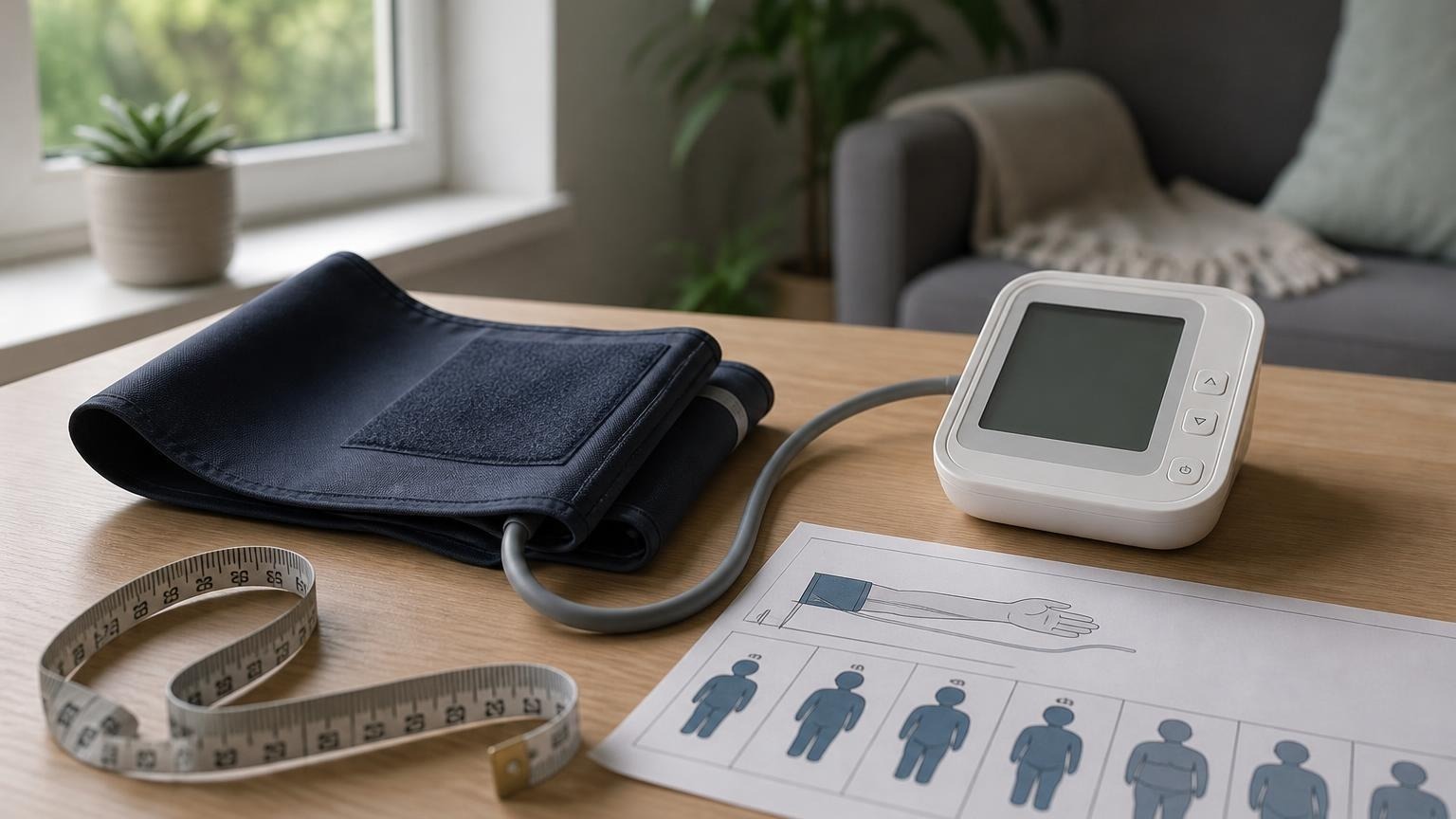
- Measure around the midpoint of the child’s bare upper arm, with the arm relaxed.
- Match that measurement to the range for the specific cuff—not a shirt size or an age-based shopping label.
- Confirm that the manufacturer identifies the cuff as compatible with the exact monitor.
- Ask a nurse or clinician to check placement and fit before relying on the setup at home.
The AAFP review of high blood pressure in children emphasizes appropriately sized cuffs and measuring arm circumference midway between the shoulder and elbow. Its clinical sizing guidance concerns the inflatable bladder inside the cuff, not merely the fabric that wraps around the arm. Parents do not need to take a cuff apart to assess it; bring the equipment to the care team instead.
Our guide to measuring arm circumference and reading cuff ranges explains the general measurement method. Its adult size examples are not a pediatric sizing chart. Likewise, a cuff labeled “small adult” describes a size category; it does not establish pediatric validation for the attached monitor.
Do not force an oversized cuff to fit by extra wrapping, put an upper-arm cuff on the forearm, or attach an unrelated small cuff because its connector happens to fit. Our replacement-cuff compatibility guide explains why matching the connector is not enough.
If home monitoring is prescribed, get a child-specific plan
Before the first home session, ask the clinician to write down:
- which monitor, cuff, and arm to use
- how long to rest and how many readings to take
- when and how often to measure
- what to do if the child moves, cries, or cannot tolerate the cuff
- which results require a call, how quickly to call, and whom to contact after hours
Do not simply copy an adult’s monitoring schedule. The purpose may be following an established condition, checking a treatment response, or collecting additional information requested by a specialist.
For a child who can sit for a routine measurement, the AAFP review describes quiet rest for three to five minutes, a supported back, uncrossed feet, and an arm supported at heart level. Have the team demonstrate an appropriately sized seated setup, including foot support if the child’s feet do not reach the floor. Pediatric clinical measurements commonly use the right arm, but follow the child’s own instructions rather than switching arms to seek a lower number.
Avoid making measurement a test the child must “pass.” Explain that the cuff will squeeze and release, keep conversation for afterward, and record movement or distress rather than hiding the context. Stop a painful or poorly tolerated session and ask for guidance instead of repeatedly restarting it.
Keep the child’s record separate from adult readings. Note the date, time, arm, actual numbers, relevant symptoms, and any difficulty with the measurement. Do not discard a result just because it looks high, and do not change, skip, or retime medication from the monitor alone.
Why an adult chart or a green indicator is not enough
The AAP’s parent-facing explanation of childhood hypertension describes why children’s blood pressure needs age, sex, and height context. A familiar adult cutoff is not a universal reassurance threshold for a younger child.
In the U.S. AAP framework summarized by AAFP, interpretation for children younger than 13 uses age-, sex-, and height-based values; adolescents 13 and older use fixed categories aligned with adult definitions. That change in interpretation does not mean every adult monitor becomes suitable on a child’s 13th birthday.
A monitor’s color bar, app label, or “normal” message may use adult categories. Record the actual systolic and diastolic numbers and let the child’s care team interpret them. Do not use the display’s color to decide whether an abnormal result needs attention.
A normal-looking home reading also should not cancel a requested clinic appointment or further investigation. If the team requests ambulatory blood pressure monitoring, that is a different test: a fitted monitor records measurements across daily activity and sleep. Great Ormond Street Hospital’s explanation describes that supervised assessment. Taking occasional readings with a household cuff is not a replacement.
What if you already checked with an adult monitor?
Keep the result and write down the monitor model, cuff used, and circumstances. Tell the pediatric team that suitability or fit was uncertain. The reading may need confirmation; it should not be treated as either a diagnosis or proof that everything is fine.
Follow any existing action plan for unexpected results. If you have no plan and the result appears high or otherwise concerning, contact the child’s clinician promptly for guidance rather than waiting to collect a week’s readings. Do not wait for an adult emergency cutoff before asking for help.
If the child has severe symptoms such as trouble breathing, a seizure, new confusion, or a severe headache with vision changes, seek emergency medical care. Do not delay care to obtain another number, and do not let a reassuring display overrule serious symptoms.
Frequently asked questions
Q: Does adding a child-size cuff make an adult monitor suitable for children?
A: No. Cuff fit, manufacturer-approved compatibility, and pediatric suitability of the monitor are separate checks. Ask the child’s care team to confirm the complete setup before relying on it.
Q: Can a teenager use the family blood pressure monitor?
A: Possibly, if the exact model is appropriate for that teenager, has relevant validation evidence, and uses a compatible cuff that fits. Adult-style blood pressure categories for older teenagers do not remove the need to check the equipment and monitoring plan.
Q: Can a normal home reading rule out high blood pressure in a child?
A: No. A home reading does not replace pediatric assessment, and an uncertain monitor or cuff can make the result misleading. Keep planned follow-up and any requested ambulatory testing even if a home display looks normal.
Sources
- AAFP: Screening and Management of High BP in Children and Adolescents — summary of the AAP guideline, including pediatric validation and limits of home monitoring.
- AAFP: High Blood Pressure in Children and Adolescents — cuff sizing, measurement technique, and age-dependent interpretation.
- AAP HealthyChildren.org: Screening & Treating Kids for High Blood Pressure — parent-facing context for pediatric assessment.
- Great Ormond Street Hospital: 24 hour ambulatory blood pressure monitoring — how clinician-arranged ambulatory testing differs from occasional home readings.
Bottom line
Choose the child’s monitoring plan before choosing the machine. A suitable setup needs pediatric evidence, a compatible cuff that fits, and clear instructions for interpreting and sharing results. A household adult monitor is not automatically that setup.
The feature image is illustrative equipment, not a pediatric product recommendation. Our general adult monitor roundups, including sitewide recommendations shown below, are not pediatric buying lists. Use the validation guide as a starting point for a discussion with the child’s clinician:
This article is educational and not medical advice. Consult a qualified clinician before making treatment decisions or starting home blood pressure monitoring for a child.
Top 5 picks
Best Blood Pressure Monitors For Seniors 2026
Five upper-arm monitors ranked with published scorecards—setup friction, comfort, readability, power convenience, and repeatable accuracy—so you can compare models before you buy.
See our Top 5 blood pressure monitor picksHome-monitoring advice is only useful if it is easy to verify and act on correctly.
We write explainers to be understandable to readers, search engines, and AI answer systems.
Compare our Top 5 blood pressure monitor picks for 2026, then track readings over time with consistent technique.