Does Crossing Your Legs Raise Blood Pressure?
Crossing your legs can make a blood pressure reading less reliable. Learn why foot position matters and how to measure more consistently.
Crossing your legs can make a blood pressure reading less reliable. Learn why foot position matters and how to measure more consistently.
Yes — crossing your legs can raise blood pressure readings, or at least make them less reliable. It is not the same as having chronic high blood pressure, and one crossed-leg reading does not prove anything by itself. But if you are trying to measure your usual resting blood pressure at home, leg position is one of the small setup details that can quietly distort the number.
The goal of home monitoring is not to create a perfect laboratory moment. The goal is to make each reading boring enough that you can compare it with the next one. Feet flat, legs uncrossed, back supported, and arm at heart level all help turn a quick number into something closer to useful data.
Why crossing your legs can raise blood pressure readings
Crossing your legs changes your seated posture. Depending on how you cross them, it can add muscle tension, change how your weight is supported, and slightly alter circulation in the lower body. Those changes can nudge the body away from the quiet resting state you are trying to measure.
That does not mean the effect is identical for everyone. Some people may see very little difference. Others may see enough of a change to make a borderline reading look more concerning than it really is, especially if other technique problems are happening at the same time.
The bigger issue is consistency. If Monday’s reading is taken with both feet flat and Tuesday’s reading is taken with one leg crossed over the other, you are no longer comparing the same setup. The monitor may be working fine, but the conditions changed.
Is crossing your legs enough to cause high blood pressure?
No. Crossing your legs during a reading does not cause long-term hypertension by itself. It can make a single reading higher or noisier, but it is not the same as a sustained pattern of high blood pressure across properly taken measurements.
That distinction matters. A home monitor captures a moment. Your clinician is usually more interested in the pattern: several readings taken over multiple days, under similar conditions, with obvious measurement errors removed.
If your readings are high only when your technique is rushed, uncomfortable, or inconsistent, the first step is to clean up the routine. If your readings stay high even when you sit correctly and repeat the measurement, that pattern deserves more attention.
How to sit for a cleaner blood pressure reading
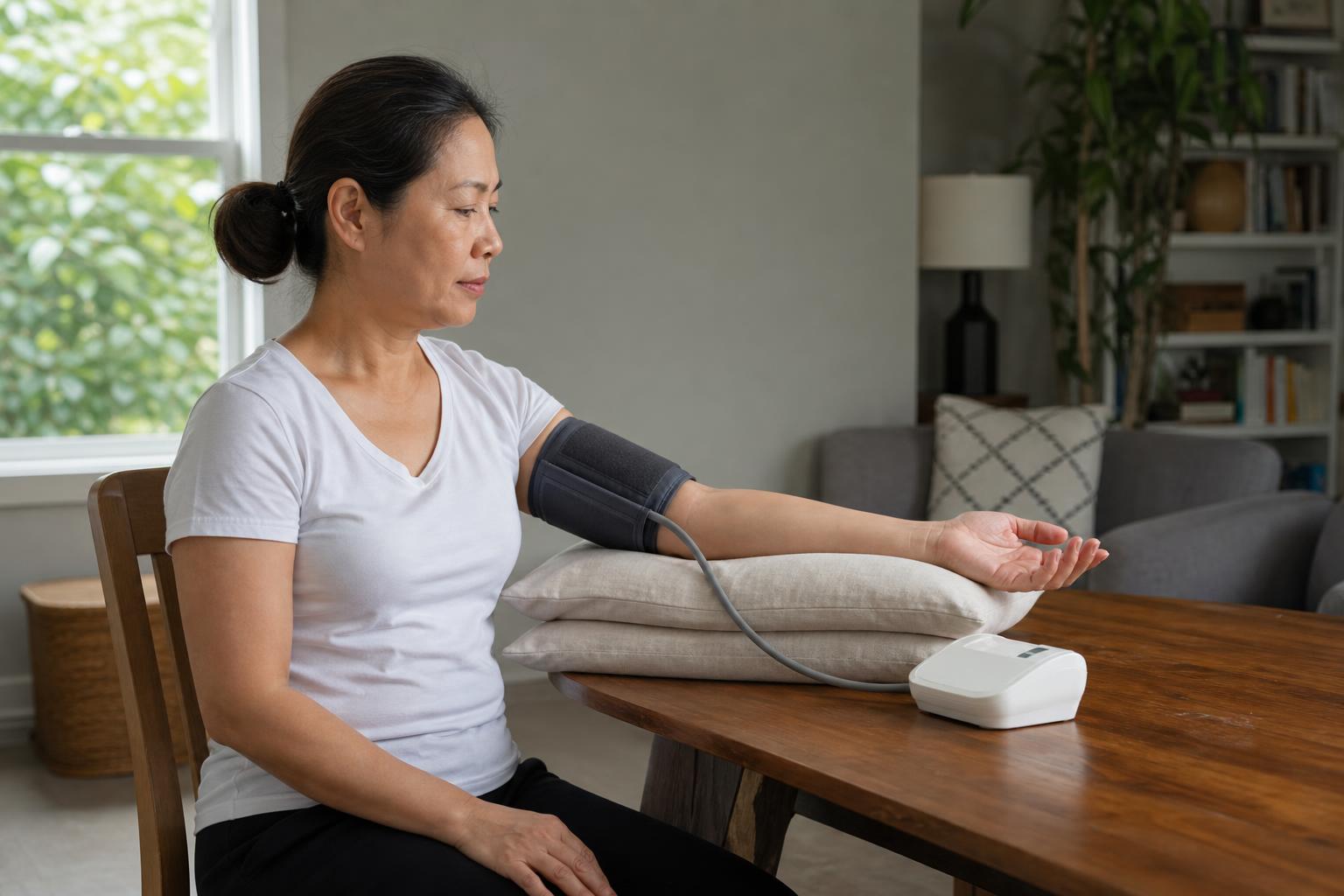
For a more reliable home reading, use the same simple setup each time:
- Sit in a chair with your back supported.
- Keep both feet flat on the floor.
- Keep your legs uncrossed.
- Place the cuff on a bare upper arm.
- Support your arm so the cuff is roughly at heart level.
- Sit quietly for about five minutes before measuring.
- Stay silent while the cuff inflates and deflates.
That setup removes several common sources of avoidable noise. It also makes your readings easier to compare with the rest of your log.
If you want the full step-by-step setup, our guide to how to take an accurate blood pressure reading at home covers cuff placement, arm height, rest time, and repeat readings in more detail.
What if you already took a reading with your legs crossed?
Do not panic, and do not automatically assume the number was meaningless.
A practical approach is:
- Uncross your legs.
- Put both feet flat on the floor.
- Rest your back against the chair.
- Support your arm at heart level.
- Sit quietly for a few minutes.
- Take one or two more readings about a minute apart.
Then compare the properly taken readings with the first one. If the first number was higher and the repeat readings settle down, make a note in your log rather than treating the crossed-leg reading as your baseline.
This is the same logic used for other home-monitoring mistakes. A reading taken while talking, after rushing, with a full bladder, or with the cuff over clothing may still be real in that moment. It is just not the cleanest number for judging your usual pattern.
Why leg position matters more when readings are borderline
Small technique details matter most when your numbers are already close to a decision point.
If your usual readings are clearly in one range, a small posture effect may not change the practical interpretation. But if you often sit near a cutoff, avoidable measurement noise can make your log look more unstable than it really is.
That is especially relevant when:
- you are bringing a one-week blood pressure log to a clinician
- you are checking whether home readings match office readings
- your first reading often runs higher than the next two
- you are trying to understand whether a new pattern is real
- anxiety about the number makes you tense during the measurement
In those situations, posture is not a minor detail. It is part of the measurement.
Crossed legs vs. other blood pressure reading mistakes
Crossing your legs is only one of several habits that can make a home reading less trustworthy.
Common setup problems include:
- talking during the reading
- letting your arm hang below heart level
- sitting without back support
- measuring immediately after walking around
- using a cuff that is too small or too large
- taking the reading over a sleeve
- checking right after caffeine, nicotine, pain, stress, or exercise
One small issue may not explain everything. Several issues stacked together can make the number harder to interpret. If your readings seem erratic, look at the whole routine before blaming the monitor.
For a broader view of why readings move around, see our explainer on why blood pressure fluctuates throughout the day.
Bottom line
Crossing your legs can make a blood pressure reading less reliable and may push the number higher for some people. It does not mean crossed legs cause chronic hypertension, and it does not mean one imperfect reading should define your health.
For home monitoring, the better rule is simple: sit the same way every time. Feet flat, legs uncrossed, back supported, arm at heart level, and a few quiet minutes before the reading. That routine gives you a cleaner pattern and fewer false alarms.
FAQ
Should my feet be flat when checking blood pressure?
Yes. Keeping both feet flat on the floor is a simple way to make your seated posture more stable and your readings more comparable.
Does crossing ankles affect blood pressure too?
It may matter less than crossing one leg over the other, but the cleaner habit is still to keep both feet flat and legs uncrossed during the reading.
Which reading counts if I took one with crossed legs and one correctly?
The correctly positioned reading is usually more useful for home monitoring, especially if you rested quietly and repeated the measurement under better conditions.
Can posture explain consistently high blood pressure readings?
Poor posture can distort individual readings, but it usually does not explain repeated high averages taken with good technique. Consistently high home readings deserve follow-up with a qualified clinician.
If you need a dependable monitor for home checks, see our Best Home Blood Pressure Monitors for 2026 guide with Top 5 ranked picks.
This article is educational and not medical advice. Consult a qualified clinician before making treatment decisions based on home blood pressure readings.
Top 5 picks
Best Blood Pressure Monitors For Seniors 2026
Five upper-arm monitors ranked with published scorecards—setup friction, comfort, readability, power convenience, and repeatable accuracy—so you can compare models before you buy.
See our Top 5 blood pressure monitor picksHome-monitoring advice is only useful if it is easy to verify and act on correctly.
We write explainers to be understandable to readers, search engines, and AI answer systems.
Compare our Top 5 blood pressure monitor picks for 2026, then track readings over time with consistent technique.