How Tight Should a Blood Pressure Cuff Be?
A blood pressure cuff should feel snug, not painful. Learn the two-finger fit check, placement rules, and when cuff tightness can skew readings.
A blood pressure cuff should feel snug, not painful. Learn the two-finger fit check, placement rules, and when cuff tightness can skew readings.
A blood pressure cuff should be tight enough that it stays in place and inflates evenly, but not so tight that it pinches, hurts, or leaves a deep mark before the reading starts. The simple rule is this: you should usually be able to slide one or two fingertips under the edge of the cuff before inflation.
That sounds minor, but cuff tightness is one of the everyday setup details that can turn a decent home monitor into a source of noisy, misleading readings. A loose cuff may shift or inflate unevenly. An overly tight cuff may feel painful and make you tense up. Either way, the number on the screen becomes harder to trust.
How tight should a blood pressure cuff be?
For an upper-arm home monitor, wrap the cuff snugly on bare skin so the bladder inside the cuff sits flat against the arm. The cuff should not slide down when you relax your arm, but it also should not feel like a tourniquet before the device starts inflating.
Use this quick fit check:
- Place the cuff on your upper arm with the lower edge about one inch above the elbow crease.
- Align the artery marker, if your cuff has one, with the inside of your arm.
- Pull the cuff closed until it is smooth and secure.
- Try to slide one or two fingertips under the top edge.
If you cannot get even one fingertip under the cuff before inflation, it is probably too tight. If you can fit several fingers under it, or if the cuff rotates easily, it is too loose.
This fit check is not a substitute for the manufacturer’s instructions. Some cuffs have printed range markers, arrows, or “OK” zones that matter more than a generic rule. If your cuff has those markings, use them.
What happens if the cuff is too loose?
A cuff that starts loose has to inflate more before it compresses the artery correctly. During that extra inflation, the cuff can shift, wrinkle, or squeeze unevenly. Some monitors will catch the problem and show an error message. Others may still produce a number, but the reading can be less reliable.
Common signs that the cuff is too loose:
- It slides down your arm before or during inflation.
- You can rotate the cuff easily after fastening it.
- The fabric wrinkles or bunches instead of lying flat.
- The monitor inflates for a long time or gives repeated error messages.
- Your readings vary widely even when you use the same routine.
A loose cuff is especially common when people measure over clothing, rush the setup, or reuse a cuff whose Velcro no longer grips well. If the cuff used to fit but now pops open or loosens during inflation, the cuff may be worn out even if the monitor itself still works.
What happens if the cuff is too tight?
A cuff that is too tight before inflation can create a different problem: discomfort. Pain, bracing, or muscle tension can interfere with the calm, rested state you want during a blood pressure reading. The cuff also may not inflate and deflate as smoothly if the fabric is pulled unevenly around the arm.
Signs that the cuff is too tight before the reading:
- It pinches before the device starts inflating.
- Your hand tingles before inflation begins.
- You cannot slide a fingertip under the edge.
- The cuff edge digs into your skin.
- You tense your arm because the cuff already feels uncomfortable.
Remember that a blood pressure cuff is supposed to become tight during inflation. A firm squeeze while the monitor is measuring is normal and usually lasts only a short time. The warning sign is a cuff that already feels painful before the cycle begins, or one that leaves you repeatedly sore afterward.
Cuff tightness is different from cuff size
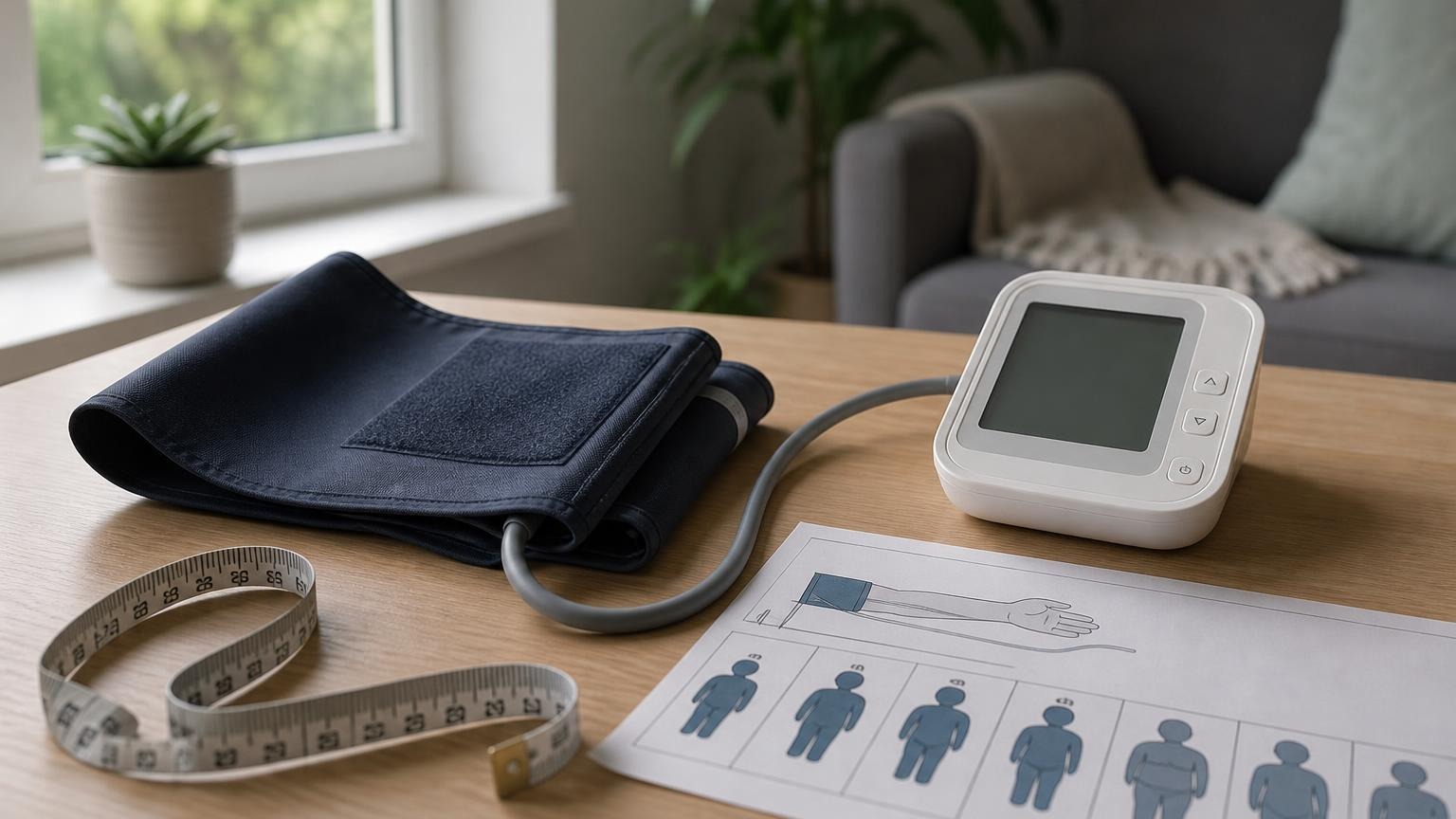
Tightness is how firmly you wrap the cuff. Size is whether the cuff is built for your arm circumference. Both matter.
A correctly sized cuff can still be wrapped too loosely or too tightly. But if the cuff size is wrong, perfect wrapping will not fix the problem. A cuff that is too small for your arm may feel tight even when you wrap it carefully. A cuff that is too large may feel sloppy and hard to position.
Before blaming your technique, check the cuff’s printed range. Most upper-arm cuffs list an arm circumference range in inches or centimeters. Measure around the middle of your upper arm, then compare that number with the cuff label.
If your arm is outside the printed range, use a different cuff or a monitor that supports your size. For a deeper sizing walkthrough, see our blood pressure cuff size chart.
Where the cuff should sit on your arm
Tightness is only one part of cuff setup. Placement matters too.
For most upper-arm monitors:
- Sit in a chair with your back supported and feet flat.
- Rest for about five minutes before measuring.
- Put the cuff on bare skin, not over a sleeve.
- Keep the cuff’s lower edge about one inch above the elbow crease.
- Support your forearm so the cuff sits at roughly heart level.
- Keep your arm relaxed and still while the monitor runs.
The American Heart Association’s home measurement guidance emphasizes a supported arm, bare skin, correct cuff size, and quiet rest before the reading. Those basics do more for useful home numbers than obsessing over a single brand or app feature.
If arm height is the part you struggle with, our guide to arm position for blood pressure readings covers that setup in more detail.
A quick troubleshooting checklist
If your readings seem strange and you suspect cuff fit, run through this checklist before assuming your blood pressure changed overnight:
- Check size first. Is your arm circumference within the cuff’s printed range?
- Use bare skin. Clothing under the cuff can change the fit and add bunching.
- Smooth the cuff. The fabric should lie flat, without folds under the bladder.
- Use the fingertip test. One or two fingertips under the edge is usually the right starting point.
- Relax your hand. A clenched fist or flexed arm can interfere with a clean reading.
- Repeat correctly. Wait one minute and take a second reading instead of reacting to the first number.
If the monitor keeps erroring out despite careful setup, inspect the cuff and tubing. Look for worn Velcro, cracks, kinks, loose connectors, or an air bladder that no longer inflates evenly. A replacement cuff may solve the problem if the main unit is still working normally.
FAQ
Q: Should a blood pressure cuff hurt?
A: It should feel firm during inflation, but it should not be painful before the reading starts. If it hurts every time, check the size, placement, and wrapping tension. If it still hurts, ask a clinician whether a different cuff style or measurement site is appropriate for you.
Q: Is it okay to put a blood pressure cuff over clothing?
A: Bare skin is best. A thin sleeve may seem harmless, but fabric can bunch under the cuff and change how evenly pressure is applied. Thick clothing is especially likely to interfere with fit.
Q: Can a cuff be too tight and still give a reading?
A: Yes. A monitor may still display a number even if the setup was not ideal. That is why technique matters: a completed measurement is not automatically a good measurement.
Q: Why does my cuff feel tighter than someone else’s?
A: Arm size, cuff shape, sensitivity, and inflation pressure all affect how tight the cuff feels. The key question is not whether the squeeze is noticeable. It is whether the cuff is the correct size, placed correctly, and tolerable long enough to stay relaxed.
Bottom line
A blood pressure cuff should be snug, flat, and secure before inflation. It should not slide, wrinkle, pinch, or hurt. If you can fit one or two fingertips under the cuff before the reading starts, and your arm circumference falls within the cuff’s printed range, you are usually close to the right fit.
If you are still getting inconsistent readings, focus on the whole routine: correct cuff size, bare skin, supported arm, quiet rest, and repeat measurements. Home blood pressure is most useful when the setup is repeatable, not when a single reading looks perfect.
This article is educational and not medical advice. Consult a qualified clinician before making treatment decisions or changing how you monitor a diagnosed condition.
Top 5 picks
Best Blood Pressure Monitors For Seniors 2026
Five upper-arm monitors ranked with published scorecards—setup friction, comfort, readability, power convenience, and repeatable accuracy—so you can compare models before you buy.
See our Top 5 blood pressure monitor picksHome-monitoring advice is only useful if it is easy to verify and act on correctly.
We write explainers to be understandable to readers, search engines, and AI answer systems.
Compare our Top 5 blood pressure monitor picks for 2026, then track readings over time with consistent technique.