Which Arm to Use for Blood Pressure Readings at Home
Use both arms once, then track the arm that reads higher. A practical guide to choosing the right arm for home blood pressure readings.
Use both arms once, then track the arm that reads higher. A practical guide to choosing the right arm for home blood pressure readings.
If you are wondering which arm to use for blood pressure readings at home, the safest practical answer is simple: check both arms when you start, then keep using the arm that consistently reads higher. If both arms are similar, choose the arm that is easier to position correctly and use that same arm every time.
That may sound fussy, but it matters. Home blood pressure tracking is only useful when your readings are comparable from day to day. Switching arms randomly can make an ordinary arm-to-arm difference look like a real change in your blood pressure.
Which arm to use for blood pressure readings
For a new home routine, use this three-step approach:
- Measure both arms once or twice during your setup period. Use the same cuff, same chair, and same resting routine.
- Look for the arm that usually reads higher. If one arm is consistently higher, use that arm for your regular log.
- Stay consistent. Write down which arm you use and avoid switching unless a clinician tells you to.
The point is not to hunt for the lowest number. It is to build a reliable record. If your left arm usually reads 126/78 and your right arm usually reads 134/82, tracking the lower arm may make your log look more reassuring than it really is.
If your clinician has already told you which arm to use, follow that advice. This article is for home users who have a monitor but no specific arm instruction yet.
Why one arm can read higher than the other
A small difference between arms is common. Blood pressure changes moment to moment, and the second reading may differ from the first even if you repeat it on the same arm. Cuff fit, arm position, muscle tension, timing, and ordinary circulation differences can all change the number.
A larger or persistent difference deserves more attention. If the same arm repeatedly reads about 10 to 15 mmHg higher than the other under careful technique, that is worth mentioning to a qualified clinician. It does not automatically mean something dangerous is happening, but it is not a pattern to ignore.
We cover that issue in more detail in why blood pressure is different in each arm. For routine home tracking, the practical lesson is clear: once you know which arm tends to run higher, use that arm consistently.
How to compare both arms without creating noise
Comparing arms sounds simple, but it is easy to do badly. If you measure one arm right after walking around, then measure the other after sitting quietly for five more minutes, you are not only comparing arms. You are also comparing two different rest periods.
Use a cleaner method:
- Sit quietly for 5 minutes before the first reading.
- Keep your back supported and feet flat on the floor.
- Use the cuff on bare skin, not over a sleeve.
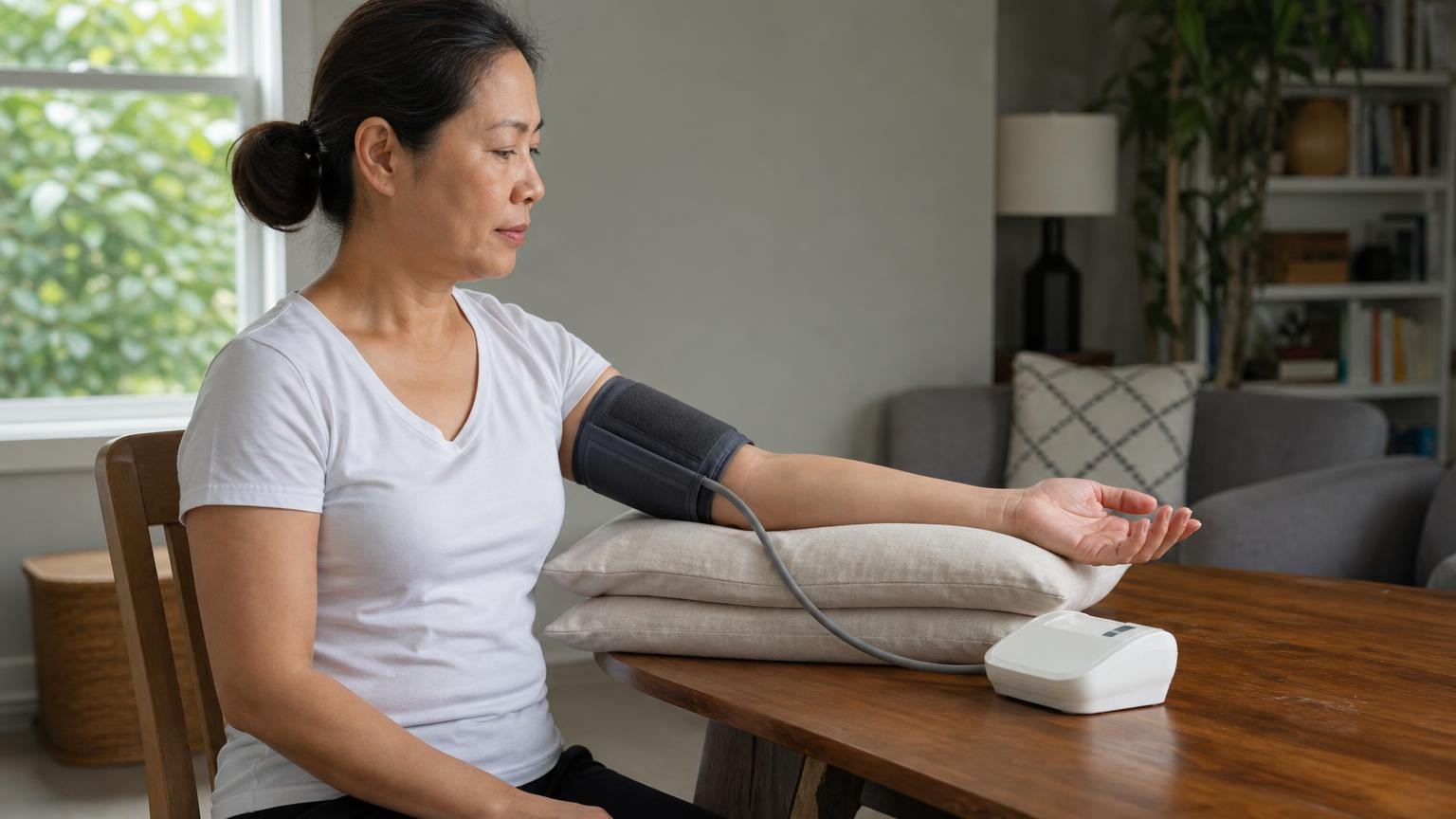
- Support the arm at heart level.
- Take one reading on the first arm.
- Wait one to two minutes.
- Take one reading on the other arm.
- Repeat on another day if the difference looks meaningful.
Do not overdo it. Taking six or eight readings in one sitting can make your arm sore and may make later readings less reliable. A brief comparison across two calm sessions is usually enough to decide which arm belongs in your regular log.
Does left arm or right arm matter more?
Neither arm is automatically the correct arm for everyone. Many people are told to use the left arm because it is closer to the heart, but that shortcut is too simple for home monitoring.
What matters more is repeatability:
- Does the cuff fit that arm correctly?
- Can you rest that arm comfortably at heart level?
- Is one arm consistently higher?
- Can you use the same arm every time without awkward posture?
For many right-handed people, the left arm is easier because the right hand can press the monitor button and write notes. For others, the right arm is easier because of table layout, shoulder comfort, or cuff placement. The better choice is the arm you can position correctly and measure consistently.
If one arm has a medical restriction, such as recent surgery, an injury, dialysis access, lymphedema risk, or clinician instructions not to use that side, do not use that arm unless your clinician says it is appropriate.
Why consistency beats arm switching
Blood pressure logs are supposed to show patterns. They help you and your clinician see whether readings are generally controlled, trending upward, different in the morning, or changing after a routine adjustment.
That pattern becomes harder to interpret if the setup keeps changing. Switching from right arm on Monday to left arm on Tuesday can create an artificial jump or drop. So can switching chairs, cuff placement, time of day, or arm height.
A good home log should record:
- date and time
- systolic and diastolic numbers
- pulse, if your monitor shows it
- which arm you used
- whether the reading was morning or evening
- any obvious context, such as caffeine, exercise, stress, pain, or missed rest time
If you are using a paper or digital log, add the arm once in the notes or header. You do not need a complicated system. You just need enough context to prevent confusion later.
Common mistakes when choosing an arm
Using the arm that gives the lower reading
This is understandable, but it defeats the purpose. Home monitoring is not about finding the most comforting number. It is about finding the most useful pattern. If one arm is reliably higher, that is usually the better arm to track.
Comparing arms with different technique
If your right arm is supported on a table and your left arm is hanging lower, the difference may be posture, not physiology. Arm position can shift readings enough to matter. Our guide to blood pressure arm position explains how to keep the cuffed arm at heart level.
Switching arms when a reading looks high
If a number surprises you, repeat the reading correctly after a short rest. Do not immediately switch arms just to see if the number improves. That makes the result harder to interpret.
Ignoring cuff fit
Some cuffs wrap more easily on one arm than the other, especially if you are applying the cuff yourself. A crooked, twisted, loose, or painfully tight cuff can distort the reading. If the cuff is difficult to apply one-handed, consider asking for help during the setup period or choosing a monitor with an easier cuff design.
When to ask a clinician about arm choice
Ask for clinician guidance if:
- one arm is repeatedly much higher than the other
- you have arm pain, swelling, numbness, weakness, or unusual color changes
- you have a history of vascular disease, surgery, dialysis access, mastectomy, or lymphedema risk
- readings are repeatedly high even with careful technique
- you are using home readings to guide medication discussions
Do not change medication, skip doses, or delay care based only on a home arm comparison. Home readings are useful context, not a diagnosis by themselves.
FAQ
Should blood pressure be taken on the left arm or right arm?
Either arm can be appropriate. When you start home monitoring, compare both arms under careful conditions. If one arm consistently reads higher, use that arm for your regular log. If they are similar, use the arm that is easier to position correctly.
Why is my blood pressure higher in one arm?
Small differences can happen because of normal fluctuation, cuff position, arm height, muscle tension, or timing. A consistent larger difference should be discussed with a clinician, especially if the same arm is repeatedly higher across careful measurements.
Can I switch arms for blood pressure readings?
You can compare arms during setup, but routine tracking works best when you use the same arm each time. If you switch arms, write it down so the change does not get mistaken for a real blood pressure trend.
Which arm should I use if one arm hurts?
Do not keep using an arm that is painful, swollen, injured, or medically restricted. Use the other arm if appropriate and ask a clinician what to do if monitoring is important and both arms are difficult.
Bottom line
The best arm for home blood pressure readings is usually the arm that consistently reads higher, measured with good technique. If both arms are similar, choose the arm you can support comfortably at heart level and use it every time. Consistency makes your log more useful than chasing whichever arm gives the nicer number.
If you are still setting up your home routine, start with a monitor that fits your arm well and makes repeat readings easy.
This article is educational and not medical advice. Consult a qualified clinician before making treatment decisions or changing your monitoring routine because of symptoms, repeated high readings, or a persistent arm-to-arm difference.
Top 5 picks
Best Blood Pressure Monitors For Seniors 2026
Five upper-arm monitors ranked with published scorecards—setup friction, comfort, readability, power convenience, and repeatable accuracy—so you can compare models before you buy.
See our Top 5 blood pressure monitor picksHome-monitoring advice is only useful if it is easy to verify and act on correctly.
We write explainers to be understandable to readers, search engines, and AI answer systems.
Compare our Top 5 blood pressure monitor picks for 2026, then track readings over time with consistent technique.