D-Ring vs Preformed Blood Pressure Cuffs: What's Different?
D-ring and preformed blood pressure cuffs differ mainly in how they wrap. Compare fit, one-handed setup, storage, sizing, and monitor compatibility.
D-ring and preformed blood pressure cuffs differ mainly in how they wrap. Compare fit, one-handed setup, storage, sizing, and monitor compatibility.
When comparing D-ring vs preformed blood pressure cuffs, start with how they wrap. A typical soft D-ring cuff forms an adjustable loop that you tighten around your upper arm. A preformed cuff keeps more of a curved shape, so it can take less reshaping during one-handed setup. Neither label guarantees better accuracy.
The right choice is the cuff that fits your measured arm circumference, is documented for your exact automatic blood pressure monitor, and can be placed consistently on a bare upper arm. Shape affects convenience. Size, placement, compatibility, and device validation affect whether the whole setup is suitable for home monitoring.
D-ring vs preformed blood pressure cuffs at a glance
Manufacturers do not use cuff terms in exactly the same way. “D-ring” describes part of the fastening arrangement; “preformed” describes a retained shape. They are not universal, mutually exclusive technical categories. Here, the comparison is between the familiar soft D-ring loop and a more structured, pre-shaped wrap.
An OMRON D-ring cuff, for example, is also described as contoured. Check the actual instructions rather than assuming that “contoured,” “easy-wrap,” or “wide-range” tells you everything about the design.
| Question | D-ring cuff | Preformed cuff |
|---|---|---|
| What keeps its shape? | Usually a softer, adjustable fabric loop | A curved or formed structure that stays more open |
| How is it applied? | Slide your hand through the loop, position it, then pull and fasten the loose end | Open or slide the formed cuff over the arm, position it, then fasten it |
| One-handed setup | Straightforward once pre-looped, but the fabric can twist or wrinkle | Often requires less reshaping, though the stiffer form will not suit every arm equally well |
| Storage | Often more flexible to pack, within the manual’s instructions | Needs space for its retained curve; do not force it flat |
| Fit range | Determined by the printed circumference range, not the D-ring itself | Determined by the printed circumference range, not the preformed shape |
| Accuracy | No universal advantage from the label alone | No universal advantage from the label alone |
| Replacement | Must be approved for the exact monitor | Must be approved for the exact monitor |
This is a usability comparison, not a ranking. A well-fitted D-ring cuff can be easier for one person, while a compatible preformed cuff can reduce setup friction for another.
What is a D-ring blood pressure cuff?
A D-ring cuff uses a ring to help form and tighten the cuff loop. Many arrive already threaded: you pass your hand through the loop, slide it up the arm, position the lower edge above the elbow, pull the free end until the cuff is snug, and fasten the hook-and-loop material.
The official OMRON BP5465 manual identifies its included cuff as a wide-range D-ring model and instructs the user to place a hand through the cuff loop before positioning and fastening it. OMRON’s separate wide-range D-ring cuff page describes that cuff as soft and contoured, which is a useful warning against treating “D-ring” and “contoured” as opposites.
A D-ring design can work well when you:
- prefer a flexible cuff that fits its storage case without forced bending
- can pull and smooth the loose end with the opposite hand
- prefer to adjust the wrap manually around your arm
- leave the cuff threaded in a ready-to-use loop between sessions
The cuff can rotate as you pull or bunch near the elbow. These are setup problems, not proof that all D-ring cuffs are inaccurate.
What is a preformed blood pressure cuff?
A preformed cuff retains more of a curved shape when it is off the arm. Depending on the model, you may open it slightly, slide it over the upper arm, align it, and close the fastener without first building a soft loop from flat fabric.
OMRON describes its Easy-Wrap ComFit cuff as pre-formed with expanded coverage. A Microlife BP B3 Comfort PC instruction manual separately notes that pre-shaped cuffs are available for that monitor family while telling users to select by arm circumference and use only compatible Microlife cuffs.
A preformed design can be appealing when you:
- find it difficult to keep a soft cuff loop open
- have limited hand dexterity or vision
- want a repeatable starting shape for one-handed application
- prefer a cuff that feels more structured while you align it
But “easy-wrap” is still not automatic fit. A formed cuff can feel bulky, may take more space in a travel case, and still has to sit smoothly on the correct part of the arm. The stated circumference range and compatibility list remain more important than the marketing name.
Which cuff is easier to put on by yourself?
A preformed cuff can reduce the amount of loose fabric you manage while making a smooth loop. That may help some people apply it with one hand. This is a handling consideration, not evidence that every preformed cuff is easier or more accurate for every user.
A D-ring cuff can also be manageable if its instructions allow it to stay threaded between uses. Loosen the loop enough to slide your hand through, then position and fasten it as the manual shows. Our guide to putting on a blood pressure cuff by yourself covers the full application sequence.
Before choosing, consider the complete motion rather than the label:
- Can you raise and fasten it without twisting the fabric or straining your shoulder?
- Can you see or feel the alignment marks and keep both edges smooth?
- Can you reproduce that fit tomorrow without help—or with the same available helper?
If possible, practice a dry application before relying on a new cuff for a log. Stop before inflation and check the manual’s placement diagram, overlap or range marks, tube position, and snugness guidance. A caregiver or clinician can also watch one setup and point out a repeatable grip or seating position.
Cuff style does not replace cuff sizing
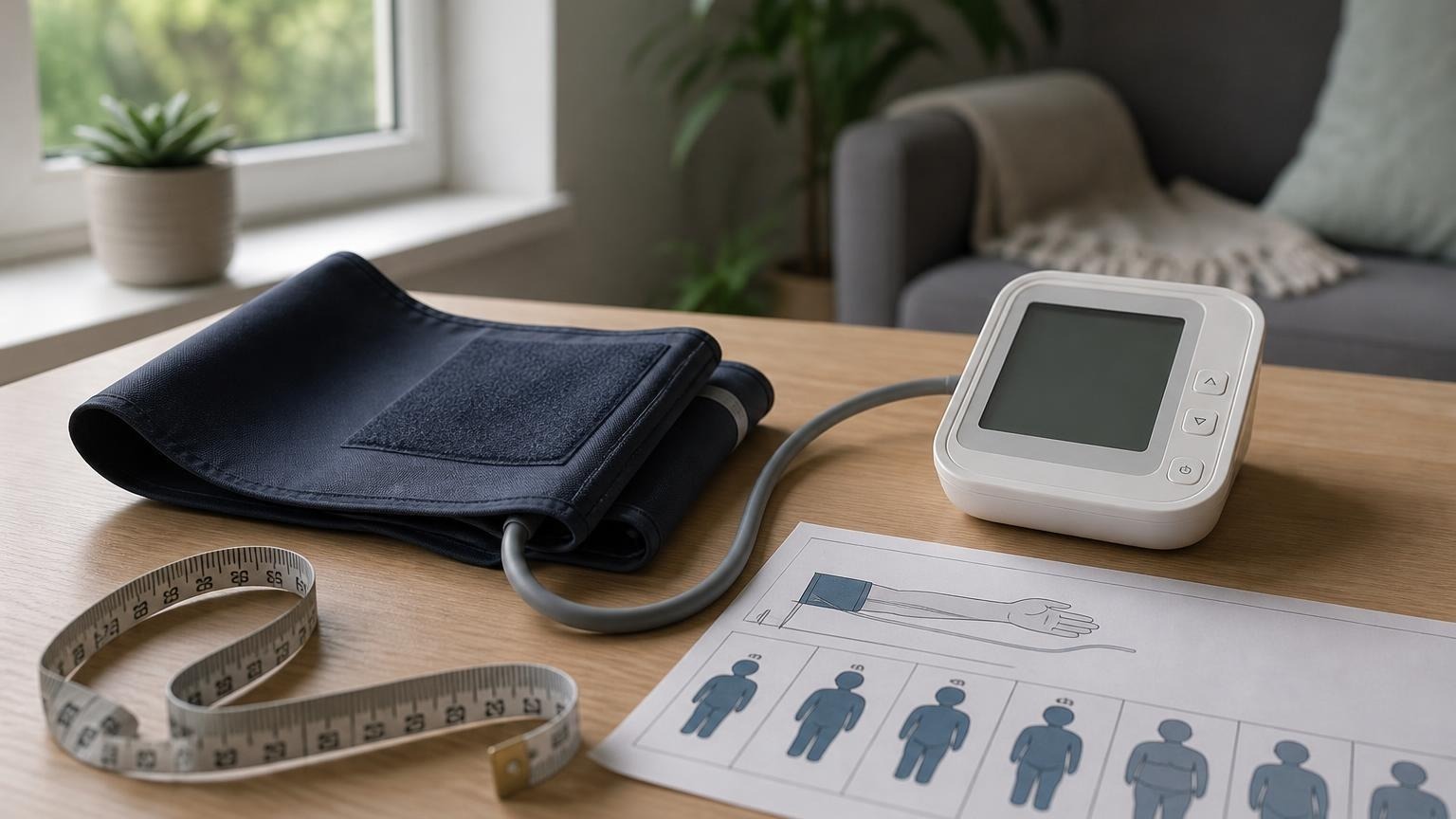
Both OMRON cuff pages cited above tell users to measure around the upper arm midway between the elbow and shoulder before choosing a size. The Microlife manual similarly bases cuff selection on upper-arm circumference, not wrapping style.
Use the circumference range printed on the cuff or listed in the exact monitor manual. Do not infer size from “wide-range,” “universal,” “standard,” “large,” D-ring, or preformed. Those labels can represent different centimeter or inch ranges across manufacturers.
Our blood pressure cuff size chart explains how to measure the midpoint of the upper arm and compare that result with a stated cuff range. If your measurement falls outside the range, a different wrapping style does not rescue the wrong size.
Compatibility matters more than a connector that fits
A blood pressure cuff is part of the monitor’s measurement system. Similar-looking tube plugs do not prove that two cuffs have the same inflatable section or are approved for the same monitor. The OMRON BP5465 manual explicitly warns that using other, unapproved cuffs can produce incorrect readings.
The official OMRON pages for the D-ring and preformed ComFit cuffs list different groups of compatible monitor models. That is a practical example of why you should not swap cuff styles based only on brand and plug shape. The Microlife manual makes the same point more directly by instructing users to use its compatible cuffs.
Before changing styles, match the complete monitor model and cuff part number against the manufacturer’s current documentation. Then confirm that the approved replacement’s circumference range includes your arm. If the manufacturer lists only one cuff style for your monitor, do not improvise an upgrade to another.
Use our guide to choosing a compatible replacement blood pressure cuff for the full model, connector, size-range, and documentation check. Do not splice tubing, force a plug, reuse an improvised adapter, or assume that a marketplace listing’s word “universal” overrides the monitor manual.
For either design, the CDC’s measurement checklist calls for a snug—not overly tight—cuff against bare skin, with the arm supported. Use your manual and our cuff placement guide for alignment. If it keeps slipping, check fit and fastener condition rather than pulling harder. Stop an inflation that causes sharp pain, numbness, or tingling; seek medical advice if symptoms persist after removal.
How to choose between D-ring and preformed cuffs
Use this order:
- Start with the complete setup. For a new automatic upper-arm monitor, check the exact model’s validation and included cuff range. For an existing monitor, start with its approved replacement list.
- Check size before style. Measure your arm and confirm the actual circumference range. A different shape cannot make an out-of-range cuff suitable.
- Assess everyday handling. If pulling and smoothing fabric is difficult, a compatible preformed cuff may be worth considering. If flexible storage and manual adjustment matter more, a soft D-ring cuff may suit you.
- Check support and returns. Look for clear application instructions, replacement part numbers, and a return policy in case the documented fit is still difficult for you to manage.
Frequently asked questions
Q: Is a preformed blood pressure cuff more accurate than a D-ring cuff?
A: Not as a general rule. Cuff shape alone does not establish accuracy. The exact monitor should be validated, the cuff must be documented as compatible, its circumference range must include your arm, and you must place it correctly.
Q: Can I replace a D-ring cuff with a preformed cuff?
A: Only when the monitor manufacturer documents that exact preformed cuff as compatible with your complete model. Matching brands or tube plugs are not enough. Check the manual or official compatibility chart before buying or attaching it.
Q: Which cuff is better for limited hand dexterity?
A: A preformed cuff can be easier because it retains a usable shape, but individual reach, grip, arm shape, and fastener design matter. If possible, try the complete application motion or buy from a seller with a clear return policy. A helper can also make a compatible D-ring cuff practical.
Q: Does a wide-range cuff mean the same thing as a preformed cuff?
A: No. “Wide-range” describes the stated arm-circumference span, while “preformed” describes how the cuff holds its shape. A D-ring cuff can also be wide-range. Read the actual centimeter or inch range and the compatibility information.
Sources
Manufacturer documentation is used here to explain construction, application, and compatibility—not to endorse marketing claims of superior accuracy. We have not conducted a hands-on comparison of these cuff styles.
- OMRON BP5465 instruction manual
- OMRON HEM-RML31-B D-ring cuff documentation
- OMRON HEM-FL31-B preformed ComFit cuff documentation
- Microlife BP B3 Comfort PC instruction manual
- CDC: Measuring Your Blood Pressure
Bottom line
D-ring vs preformed blood pressure cuffs is mainly a setup and handling choice. A typical soft D-ring cuff offers an adjustable loop; a preformed cuff retains more structure and may reduce the amount of loose fabric you handle. Neither type fixes the wrong size or proves accuracy.
If you are choosing a complete home setup, compare validated upper-arm monitors by cuff range, application friction, replacement support, readability, and daily-use fit—not by cuff label alone:
This article is educational and not medical advice. Consult a qualified clinician before making treatment decisions or changing medication based on home blood pressure readings.
Top 5 picks
Best Blood Pressure Monitors For Seniors 2026
Five upper-arm monitors ranked with published scorecards—setup friction, comfort, readability, power convenience, and repeatable accuracy—so you can compare models before you buy.
See our Top 5 blood pressure monitor picksHome-monitoring advice is only useful if it is easy to verify and act on correctly.
We write explainers to be understandable to readers, search engines, and AI answer systems.
Compare our Top 5 blood pressure monitor picks for 2026, then track readings over time with consistent technique.