Are Home Blood Pressure Monitors Accurate With Atrial Fibrillation?
Atrial fibrillation can make automatic readings more variable. Learn how to choose a monitor, repeat measurements, and know when to get a device check.
Atrial fibrillation can make automatic readings more variable. Learn how to choose a monitor, repeat measurements, and know when to get a device check.
Are home blood pressure monitors accurate with atrial fibrillation? Some can produce useful readings, but atrial fibrillation (AFib) makes automatic measurement harder, and performance differs by exact model. An irregular rhythm creates beat-to-beat changes that can challenge the algorithms used by automatic blood pressure monitors.
Do not assume a monitor is suitable for AFib just because it shows a heart icon or advertises rhythm detection. Blood pressure accuracy and AFib screening are two separate questions. The safer approach is to use a validated upper-arm monitor, look for evidence involving people with AFib when possible, take repeated readings as your clinician directs, and bring the monitor to an appointment for a technique and device check.
Are blood pressure monitors accurate with atrial fibrillation?
They can be, but there is no reliable all-devices answer. A completed reading from a suitable monitor is not automatically wrong because you have AFib. At the same time, one plausible-looking result does not prove that the monitor performs well during an irregular rhythm.
Use this distinction:
| What you see | What it means | Useful next step |
|---|---|---|
| Complete readings that are reasonably consistent | The monitor may be giving a usable pattern | Keep following the measurement plan agreed with your clinician |
| Wide swings or repeated error screens | AFib, technique, cuff fit, power, or device performance may be involved | Correct the basic setup, preserve the results, and arrange a device check if the problem continues |
| A generic irregular-heartbeat icon | The pulse intervals looked uneven during that measurement | Repeat carefully and log recurring alerts; do not treat the icon as an ECG diagnosis |
| A dedicated AF-detection result | A studied algorithm may be screening for AF | Follow the model instructions and obtain ECG-based medical confirmation before treatment decisions |
AFib should not be used as a reason to discard every inconvenient number. It is a reason to rely less on one reading and more on a consistent, clinician-reviewed series.
Why AFib makes automatic blood pressure measurement harder
Most home automatic blood pressure machines use the oscillometric method. The cuff senses small pressure pulses as it inflates or deflates, and the monitor’s algorithm estimates systolic and diastolic pressure from that signal.
During AFib, the time between beats is irregular. The amount of blood pumped with each beat can also vary. That creates a less uniform cuff signal than the algorithm sees during a steady rhythm. The monitor may still complete the calculation, but results can be more variable, and different models may handle the same rhythm differently.
Ordinary measurement problems still matter. A cuff that is too small, an unsupported arm, talking, movement, weak batteries, or a rushed reading can add noise on top of the rhythm variation. Start by controlling those fixable variables rather than blaming every unusual number on AFib.
What the research says about automatic monitors and AFib
The evidence is useful but not simple enough to support a blanket promise.
A 2019 systematic review and meta-analysis in the Journal of Human Hypertension examined 13 studies covering 14 automated devices. Results varied considerably between devices. The authors concluded that monitors should be judged on individual performance and found no evidence that adding an AF-detection algorithm automatically made blood pressure measurement more accurate during AFib.
A separate 2019 review and meta-analysis in Hypertension found that automated measurement could still be clinically useful in AFib, while emphasizing limited and methodologically varied validation evidence. It also noted greater beat-to-beat variability and supported repeated measurements rather than reliance on a single result.
Those findings are not truly contradictory. They point to the same practical limit: an automatic cuff can be useful for someone with AFib, but accuracy depends on the exact device, the measurement method, and the pattern across repeated readings.
AF screening is a different feature. A 2024 systematic review in Hypertension pooled 23 studies involving 11,093 people and found high overall screening performance for the dedicated AF-detection algorithms that were studied. The authors still stated that an AF diagnosis requires ECG verification before treatment. That evidence does not turn every generic irregular-heartbeat icon into a diagnostic test, and it does not prove the blood pressure estimate itself is accurate in AFib.
How to choose a home blood pressure monitor when you have AFib
Start with the same fundamentals that matter for every home user, then add an AFib-specific evidence check.
- Choose an automatic upper-arm monitor. The American Heart Association’s home-monitoring guidance recommends a validated upper-arm cuff-style monitor rather than a wrist or finger device for routine home use.
- Check the complete model number. Validation belongs to an exact model, not automatically to an entire brand or product family. Use our guide to checking whether a blood pressure monitor is validated as a starting point.
- Look for evidence in people with AFib. General validation is valuable, but it may not include participants with arrhythmias. Ask the manufacturer for the relevant validation publication or ask a clinician whether the model has appropriate evidence for your situation.
- Fit the cuff to your measured arm. An AFib feature cannot correct a cuff that is outside its printed circumference range. Check the blood pressure cuff size chart and measuring steps before buying or replacing a cuff.
- Bring the whole setup to an appointment. Take the monitor, cuff, manual, and a short log. A clinician can watch your technique and decide whether a structured comparison or a different monitoring plan is appropriate.
Do not choose solely by a heart symbol on the box. A simple validated monitor that performs appropriately for you may be more useful than a feature-heavy model with unclear evidence.
How to take home readings when your rhythm is irregular
Follow the schedule your clinician gave you. If you do not have one, ask how many readings and days they want rather than building an exhausting routine around every pulse change.
For a normal home session:
- Avoid exercise, nicotine, and caffeine for at least 30 minutes beforehand when practical.
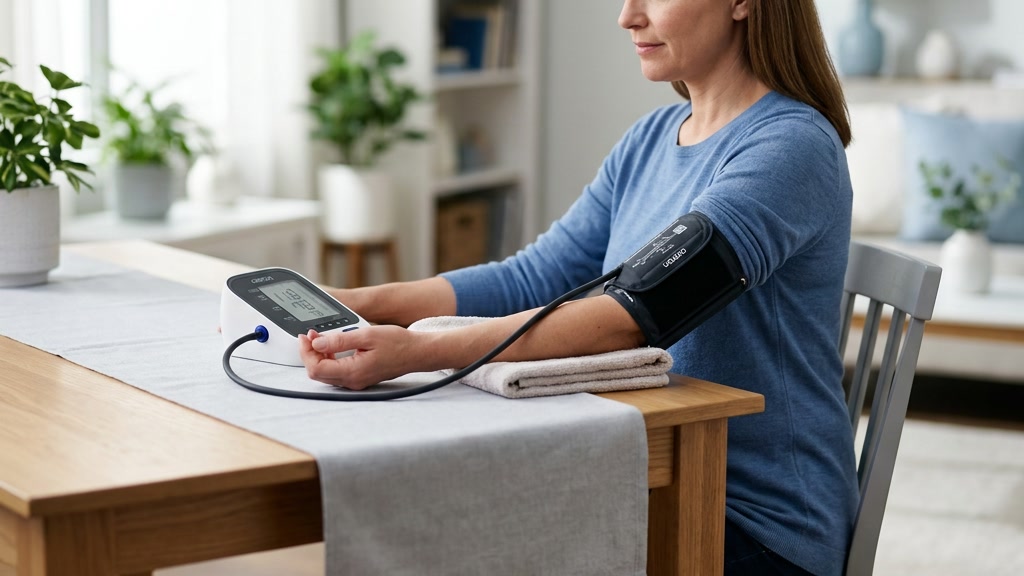
- Empty your bladder, then sit quietly for at least 5 minutes.
- Place the correctly sized cuff on bare upper arm.
- Keep your back supported, feet flat, and cuffed arm supported around heart level.
- Stay still and silent while the monitor runs.
- Record the complete systolic, diastolic, and pulse result plus any error or rhythm symbol.
- Wait about one minute before the next planned reading.
The AHA generally recommends two home readings one minute apart. Because AFib increases beat-to-beat variability, a clinician may ask some patients to take three readings or use a different schedule. Follow that individualized plan; do not keep pressing Start until the lowest number appears.
Log failed cycles separately from completed readings. An error code is not a blood pressure value, and it should not be averaged as if it were zero. If the monitor repeatedly fails to finish, contact the manufacturer and clinician rather than improvising a correction.
Does an irregular-heartbeat symbol mean the number is wrong?
Not automatically. A rhythm alert tells you what the monitor noticed about pulse timing; it does not by itself tell you whether the blood pressure result is accurate.
Movement, talking, coughing, muscle tension, and an actual irregular rhythm can all trigger some generic alerts. Dedicated AF-detection algorithms have different instructions and evidence. Check the exact manual instead of assuming every heart-shaped symbol means AFib.
Our guide to the irregular-heartbeat symbol on a blood pressure monitor explains how to handle a one-time alert versus a repeated pattern. If you already have diagnosed AFib, ask your clinician how they want alerts labeled in your log. Do not use the presence or absence of a symbol to start, stop, or adjust heart or blood pressure medication.
When to have the monitor or reading pattern checked
Arrange a clinician or manufacturer check when:
- the monitor cannot complete measurements despite correct setup
- results remain unusually scattered across several calm sessions
- a second validated monitor gives a consistently different pattern under controlled conditions
- the cuff, tube, connector, display, or power system is damaged
- the model has no clear validation information for your intended use
- you are unsure which readings should go into a clinician-facing average
Bring the unedited log, including high, low, and failed readings. The goal is not to prove that one device is right from one side-by-side test. It is to determine whether your equipment and routine produce a useful pattern.
Symptoms take priority over troubleshooting. Call emergency services for chest pain, severe shortness of breath, fainting, new weakness or numbness on one side, trouble speaking, new confusion, or other severe sudden symptoms. Do not wait for another cuff cycle or an AFib icon before seeking help.
Sources and evidence
- American Heart Association: Home Blood Pressure Monitoring
- Clark et al., 2019: Accuracy of automated blood pressure measurements in the presence of atrial fibrillation
- Stergiou et al., 2019: Blood pressure measurement in atrial fibrillation
- Stergiou et al., 2024: Atrial fibrillation screening during automated blood pressure measurement
Frequently asked questions
Q: Can an automatic blood pressure monitor be accurate if I have AFib?
A: It can provide useful readings, but performance differs by exact model and results may be more variable. Use a validated upper-arm monitor, look for AFib-specific evidence when possible, take repeated readings as directed, and bring the device to a clinician for a technique and performance check.
Q: Does AFib make blood pressure readings falsely high or falsely low?
A: Do not assume a predictable direction. An irregular rhythm can increase variability or cause failed measurements, but there is no safe correction to add or subtract at home. Keep the complete results and let a clinician review the pattern.
Q: Does an AFib or irregular-heartbeat symbol mean the blood pressure number is wrong?
A: Not automatically. Rhythm detection and blood pressure estimation are separate functions. Repeat the reading with good technique, record the symbol, and follow the exact model instructions. Repeated alerts may need ECG-based medical evaluation.
Q: Should I take three blood pressure readings if I have AFib?
A: The American Heart Association generally advises two home readings one minute apart. Because AFib can increase beat-to-beat variability, your clinician may ask for three readings or another schedule. Follow that plan rather than taking repeated measurements until a preferred number appears.
Bottom line
Home blood pressure monitors can be useful with atrial fibrillation, but no heart icon makes every model reliable for every person. Choose a validated upper-arm device, check for evidence involving AFib, use the right cuff, repeat readings consistently, and have the monitor reviewed when results stay erratic. Treat AF screening as a prompt for ECG confirmation, not as a home diagnosis.
If your current device is difficult to fit, validate, or use consistently, compare upper-arm options while keeping AFib-specific suitability as a clinician-reviewed requirement:
This article is educational and not medical advice. Consult a qualified clinician before making treatment decisions, changing medication, or interpreting AFib from home monitor readings.
Top 5 picks
Best Blood Pressure Monitors For Seniors 2026
Five upper-arm monitors ranked with published scorecards—setup friction, comfort, readability, power convenience, and repeatable accuracy—so you can compare models before you buy.
See our Top 5 blood pressure monitor picksHome-monitoring advice is only useful if it is easy to verify and act on correctly.
We write explainers to be understandable to readers, search engines, and AI answer systems.
Compare our Top 5 blood pressure monitor picks for 2026, then track readings over time with consistent technique.