Does Clenching Your Fist Affect a Blood Pressure Reading?
Clenching your fist can make a blood pressure reading less representative. Learn how to relax your hand and reset after a tense measurement.
Clenching your fist can make a blood pressure reading less representative. Learn how to relax your hand and reset after a tense measurement.
Clenching your fist can affect a blood pressure reading because it activates muscles in your hand, forearm, and sometimes your upper arm and shoulder. The change may not move every reading in the same way, but it makes the measurement less representative of a quiet resting state. Keep your cuffed arm supported and let your hand rest open rather than squeezing, gripping, or making a fist.
If you notice that you clenched during a reading, do not try to calculate a correction. Relax, let the cuff deflate, wait briefly, and repeat the measurement under your usual resting conditions.
Does clenching your fist affect a blood pressure reading?
Yes, it can make the result less dependable for comparison. A home blood pressure routine is meant to capture a calm baseline. Clenching your fist introduces muscle effort at the same time the cuff is detecting small pulse-related pressure changes in your upper arm.
Fist clenching often spreads beyond the fingers. You may also:
- tighten your forearm
- flex the upper arm under the cuff
- lift or press the shoulder forward
- brace against the table
- hold your breath
- shift the cuffed arm
Those changes can add noise to the measurement or trigger a movement warning on some monitors. A monitor may also produce a number without showing an error, which is why your technique still matters even when the screen looks normal.
There is no reliable amount you can subtract from a reading taken with a clenched fist. The practical fix is to repeat the measurement correctly, not adjust the number yourself.
How to position your hand during a blood pressure reading
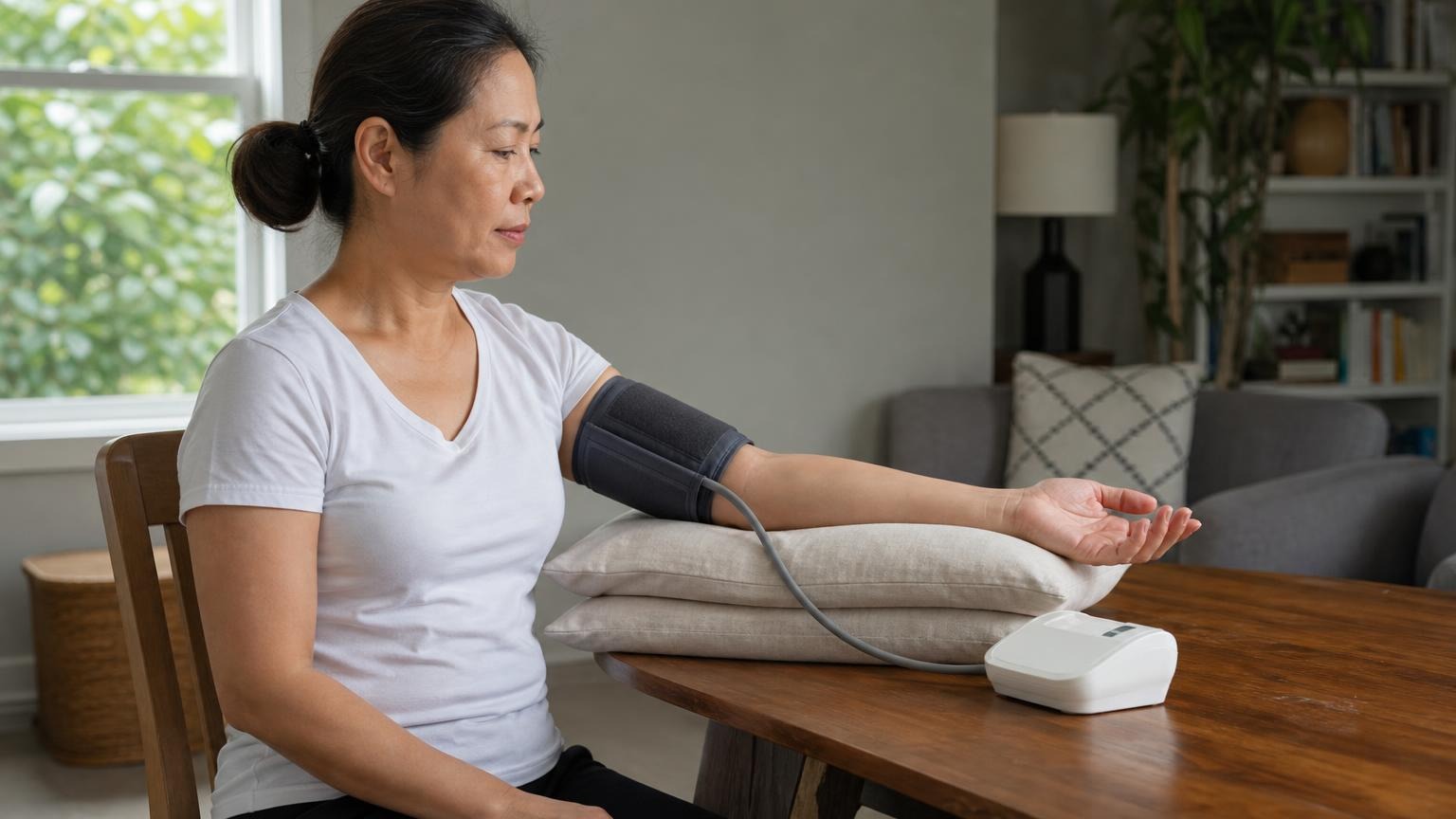
Your hand should be relaxed, with the fingers resting naturally. It does not need to be perfectly flat or held in a special pose. Palm-up is often comfortable when the forearm rests on a table or cushion, but the main goal is to avoid muscle tension.
Use this setup:
- Sit in a stable chair with your back supported and feet flat.
- Put the cuff on bare upper arm according to the monitor instructions.
- Rest your forearm on a table, pillow, or cushion so the cuff is near heart level.
- Let your elbow bend naturally rather than locking it straight.
- Open your hand and allow the fingers to curl loosely.
- Relax your shoulder, jaw, and forearm.
- Press start, then stay quiet and still while breathing normally.
Do not hold the hand rigidly open. That is another form of muscle effort. A comfortable, neutral position is better than forcing the palm or fingers into an exact angle.
For the rest of the setup, see our guide to taking an accurate blood pressure reading at home. If the arm itself is too high, too low, or unsupported, our arm-position guide explains how to correct it.
Why people clench their hand while the cuff inflates
Most people do not clench deliberately. The cuff begins to squeeze, and the body braces in response. You may grip the chair, press your fingertips into the table, or curl your hand without noticing.
Common triggers include:
- cuff pressure that feels unfamiliar
- watching the display rise during inflation
- anxiety about the result
- trying too hard to remain still
- an unsupported forearm
- a cuff that is too small, poorly placed, or wrapped too tightly
- repeated measurements taken while frustrated
A properly fitted cuff will feel firm during inflation, but persistent sharp pain, numbness, skin injury, or repeated excessive reinflation deserves attention. Stop the attempt, check the cuff size and placement, and consult the manual. Our guide to why a blood pressure cuff gets too tight covers the common fit and setup problems.
What to do if you clenched your fist during the reading
Treat the clenched fist as a technique note, not a reason to panic or hide the result.
- Let the monitor finish and the cuff fully deflate.
- Keep sitting instead of standing up or immediately rewrapping the cuff.
- Rest the forearm securely near heart level.
- Open the hand and gently loosen the fingers, wrist, shoulder, and jaw.
- Resume ordinary breathing.
- Wait about one minute, or longer if you still feel tense.
- Take one repeat reading using your normal routine.
If you maintain a detailed log, keep the first number and note “hand clenched” or “arm tense.” Do not keep repeating until you get the number you hoped to see. A complete log with brief context is more useful than a record containing only selected results.
If clenching happens every time, rehearse the position before turning on the monitor. Place the arm, let the fingers go soft, drop the shoulder, and look away from the screen. You can also ask another person to observe your posture without talking during the actual measurement.
A relaxed hand does not guarantee a low reading
Good technique is about getting a representative number, not forcing a reassuring one. Your blood pressure may still be higher or lower than expected after you relax your hand. Timing, recent activity, caffeine, nicotine, pain, stress, bladder fullness, temperature, cuff fit, and ordinary biological variation can all affect the context.
Use the same reasonable routine from day to day and pay attention to the pattern. If readings are repeatedly outside the range your clinician gave you, share the log rather than changing medication or treatment based on one home result.
Seek urgent medical care for severe or concerning symptoms such as chest pain, severe shortness of breath, fainting, new weakness, trouble speaking, or a sudden severe headache. Do not delay care while repeatedly checking the monitor.
Frequently asked questions
Q: Should your hand be open when taking blood pressure?
A: Yes. Let the cuffed hand rest open with the fingers naturally relaxed. Do not force the fingers straight or hold the palm rigidly; the goal is to avoid gripping and muscle tension.
Q: Can clenching your fist make blood pressure read higher?
A: It may contribute to a higher or less stable result because clenching activates muscles and can make you brace the arm or shoulder. The size and direction of the change are not predictable from one measurement, so repeat after relaxing instead of applying a correction.
Q: Should your palm face up or down during a blood pressure reading?
A: Palm-up is often a comfortable way to relax the forearm on a table, but the exact palm angle matters less than keeping the arm supported, the cuff near heart level, and the hand loose. Follow your monitor’s instructions if they specify a position.
Q: Does squeezing a ball affect a blood pressure reading?
A: Yes. Squeezing a ball is active hand and forearm exercise, so it should not be done during a resting blood pressure measurement. Put the object down, rest quietly, and measure after you have returned to your normal baseline.
Q: Should I repeat a reading if my fist was clenched?
A: A single repeat is reasonable after you relax and wait briefly. Keep or label the original result if you are maintaining a complete log, and avoid taking many readings in a row just to find a preferred number.
Bottom line
Clenching your fist can make a blood pressure reading less representative by adding muscle tension and movement to the measurement. Support the forearm, relax the shoulder and jaw, keep the hand gently open, and breathe normally until the cuff deflates.
If you clenched during a reading, reset and repeat once rather than trying to adjust the number. Consistent technique and trends over time are more useful than chasing a perfect single result.
This article is educational and not medical advice. Consult a qualified clinician before making treatment decisions or changing medication based on home readings.
Top 5 picks
Best Blood Pressure Monitors For Seniors 2026
Five upper-arm monitors ranked with published scorecards—setup friction, comfort, readability, power convenience, and repeatable accuracy—so you can compare models before you buy.
See our Top 5 blood pressure monitor picksHome-monitoring advice is only useful if it is easy to verify and act on correctly.
We write explainers to be understandable to readers, search engines, and AI answer systems.
Compare our Top 5 blood pressure monitor picks for 2026, then track readings over time with consistent technique.