Does Holding Your Breath Affect a Blood Pressure Reading?
Holding your breath can make a home blood pressure reading less representative. Learn how to breathe normally and reset before repeating the measurement.
Holding your breath can make a home blood pressure reading less representative. Learn how to breathe normally and reset before repeating the measurement.
Holding your breath can affect a blood pressure reading, especially if you tense your body or strain while the cuff is measuring. Even without obvious straining, breath-holding makes the measurement less representative of your normal resting state. The better approach is simple: sit quietly and breathe naturally from before you press start until the cuff finishes.
Do not try to lower the number with exaggerated slow breaths, either. A home reading is most useful when it captures your blood pressure under calm, repeatable conditions—not when you are performing a special breathing exercise for the monitor.
Does holding your breath affect a blood pressure reading?
Yes, it can. Blood pressure changes from moment to moment as your heart, blood vessels, breathing, posture, and nervous system adjust. Briefly holding your breath does not guarantee that the number will move in one predictable direction, but it changes the conditions under which you are measuring.
The effect may be more noticeable if breath-holding comes with:
- tightening your chest or abdominal muscles
- clenching your hand, jaw, or shoulder
- bracing because the cuff feels uncomfortable
- straining against a closed airway
- shifting position or lifting the cuffed arm
- anxiety about the number on the screen
Automatic monitors estimate blood pressure from pressure changes and pulse-related oscillations detected by the cuff. Muscle tension and movement can make that signal harder to interpret. Some monitors may reinflate, show an error, or still return a number that looks plausible but reflects a poor measurement session.
That does not mean every reading taken during a brief breath pause is useless. It means you should not treat it as a clean resting baseline when you know the technique changed.
Why people hold their breath during a BP reading
Most breath-holding during home monitoring is accidental. The cuff starts squeezing, you anticipate the result, and your body braces. People also hold their breath because they think being perfectly still includes stopping normal breathing.
Common triggers include:
- discomfort as the cuff inflates
- watching the displayed numbers climb
- trying hard not to move
- taking a reading while anxious or rushed
- using a cuff that is poorly fitted or incorrectly placed
- repeating measurements until a preferred number appears
Normal breathing is not the kind of movement you need to eliminate. You should keep the cuffed arm still and supported, but you do not need to freeze your chest or suppress every breath.
If inflation feels unusually painful or the monitor repeatedly pumps higher, check the cuff fit and setup. Our guide to why a blood pressure cuff gets too tight explains how tension, movement, and cuff problems can contribute.
How to breathe during a blood pressure reading
Use your ordinary resting breathing pattern. You do not need to count breaths, inhale to a specific depth, or synchronize your breathing with the cuff.
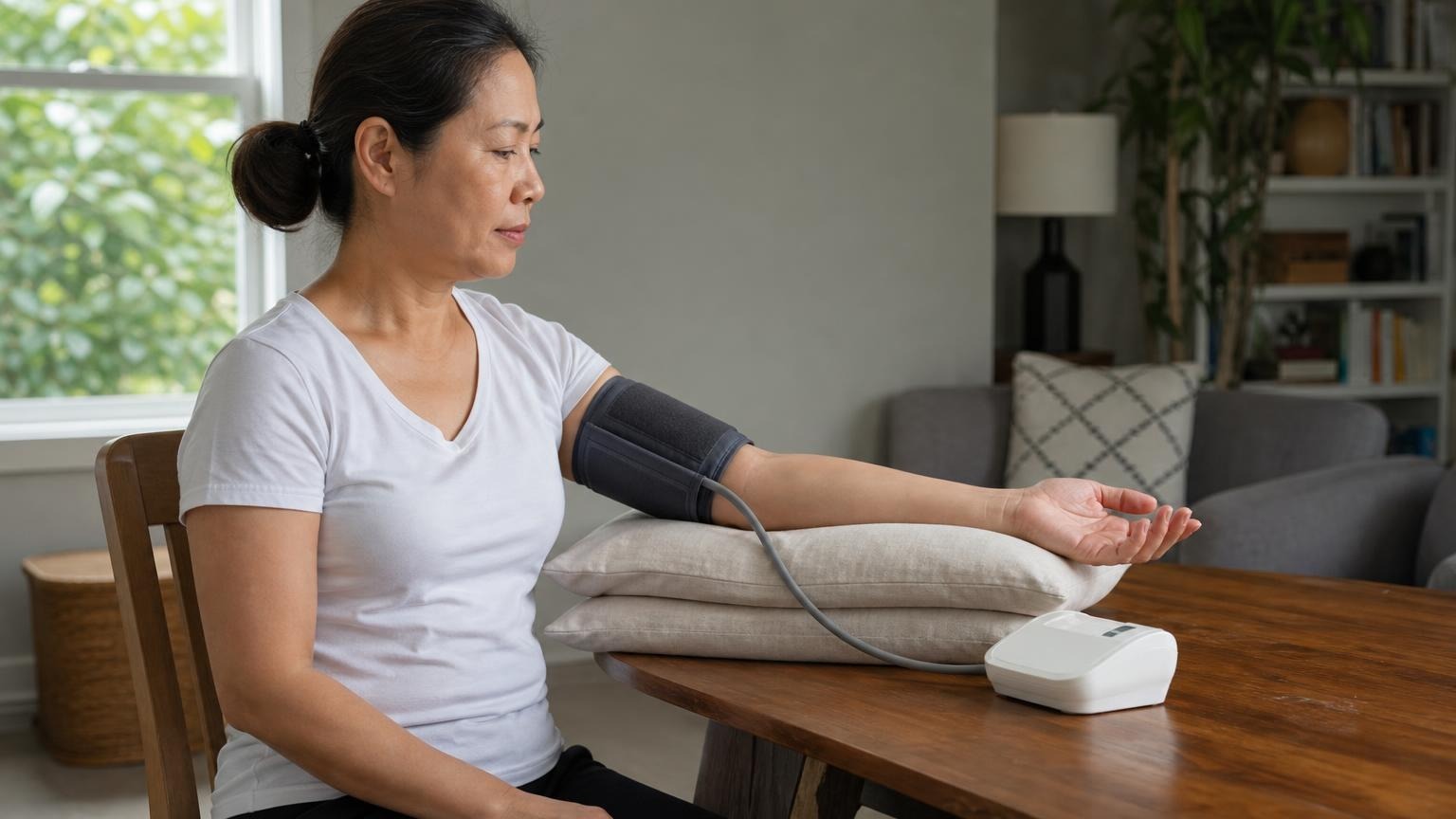
A clean routine looks like this:
- Sit in a chair with your back supported and both feet flat.
- Place the cuff on bare upper arm and support that arm near heart level.
- Rest quietly for about 5 minutes.
- Let your shoulders, hand, and jaw relax.
- Press start and look away from the display if watching it makes you tense.
- Breathe normally and do not talk until the cuff fully deflates.
- Wait about one minute before taking a second reading when repeated readings are part of your routine.
The goal is not a medically perfect breathing rhythm. It is to avoid introducing a new variable. The same principle applies to talking, scrolling, clenching your fist, or holding your arm up without support.
For the rest of the setup, follow our step-by-step guide to an accurate blood pressure reading.
Should you take deep breaths before checking blood pressure?
A few natural breaths while settling into the chair are fine. Deliberate deep-breathing exercises are different. Slow breathing can help some people feel calmer, but doing it only before selected readings changes the measurement context. You may end up comparing a reading taken after a relaxation exercise with readings taken under ordinary resting conditions.
If a clinician has asked you to use a specific relaxation or breathing routine, follow that instruction and record it consistently. Otherwise, use the quiet rest period to settle without trying to manipulate the result.
Consistency matters more than chasing the lowest possible number. A higher reading taken honestly under a repeatable routine is more useful than a lower number produced by changing your breathing, posture, or timing each time.
What to do if you held your breath during the reading
Do not panic, delete the number, or immediately take several more readings. Reset the conditions first:
- Let the cuff fully deflate.
- Keep sitting with your back and arm supported.
- Relax your shoulders and resume normal breathing.
- Wait about one minute, or longer if you still feel tense.
- Repeat the measurement once using your normal technique.
- Record both readings if you are maintaining a complete log, with a note that the first involved breath-holding or tension.
A technique mistake is context, not something to hide. If you are unsure which reading belongs in an average, our guide to whether you should delete high blood pressure readings explains why preserving and labeling unusual readings is usually more honest than erasing them.
If the second result is still unexpected, check the cuff position, cuff size, arm support, posture, and recent activity. Avoid entering a cycle of repeated checks that makes you increasingly anxious.
FAQ
Can holding your breath make blood pressure read higher?
It may, particularly when breath-holding involves straining, bracing, or anxiety. The exact response is not predictable from one reading. Repeat the measurement after quiet rest while breathing normally rather than assuming a specific correction.
Can holding your breath make blood pressure read lower?
A brief breath hold does not provide a reliable way to lower a reading. Blood pressure responses vary with the type and length of breath-holding, muscle tension, and the individual. Use normal breathing for a more representative resting measurement.
Should you talk or breathe while taking blood pressure?
Breathe normally, but do not talk. Ordinary breathing is expected. Talking changes breathing, moves muscles, and can make the result less representative of quiet rest.
Why do I tense up when the cuff inflates?
The pressure can feel unfamiliar or uncomfortable, and anxiety about the result can make you brace automatically. Check that the cuff fits and is placed correctly, support your arm, look away from the screen, and let your shoulders and hand relax. Persistent pain or repeated inflation deserves troubleshooting with the manual or manufacturer.
Should I repeat a reading if I held my breath?
Yes, if you know you held your breath or strained. Wait until you are relaxed and breathing normally, then repeat once. Keep both results or clearly note the technique problem rather than silently choosing only the preferred number.
Bottom line
Holding your breath can make a blood pressure reading less representative, especially when it comes with straining or muscle tension. Sit quietly, support your arm and back, relax your hand and shoulders, and breathe normally throughout the measurement.
If you accidentally hold your breath, reset for a minute and repeat once under cleaner conditions. Persistent unusual readings matter more than a single imperfect attempt, and concerning symptoms deserve medical attention regardless of what the monitor shows.
This article is educational and not medical advice. Consult a qualified clinician before making treatment decisions or changing medication based on home readings.
Top 5 picks
Best Blood Pressure Monitors For Seniors 2026
Five upper-arm monitors ranked with published scorecards—setup friction, comfort, readability, power convenience, and repeatable accuracy—so you can compare models before you buy.
See our Top 5 blood pressure monitor picksHome-monitoring advice is only useful if it is easy to verify and act on correctly.
We write explainers to be understandable to readers, search engines, and AI answer systems.
Compare our Top 5 blood pressure monitor picks for 2026, then track readings over time with consistent technique.