How to Take Someone Else's Blood Pressure at Home
Learn how to take someone else's blood pressure at home with correct cuff placement, positioning, logging, and safety caveats.
Learn how to take someone else's blood pressure at home with correct cuff placement, positioning, logging, and safety caveats.
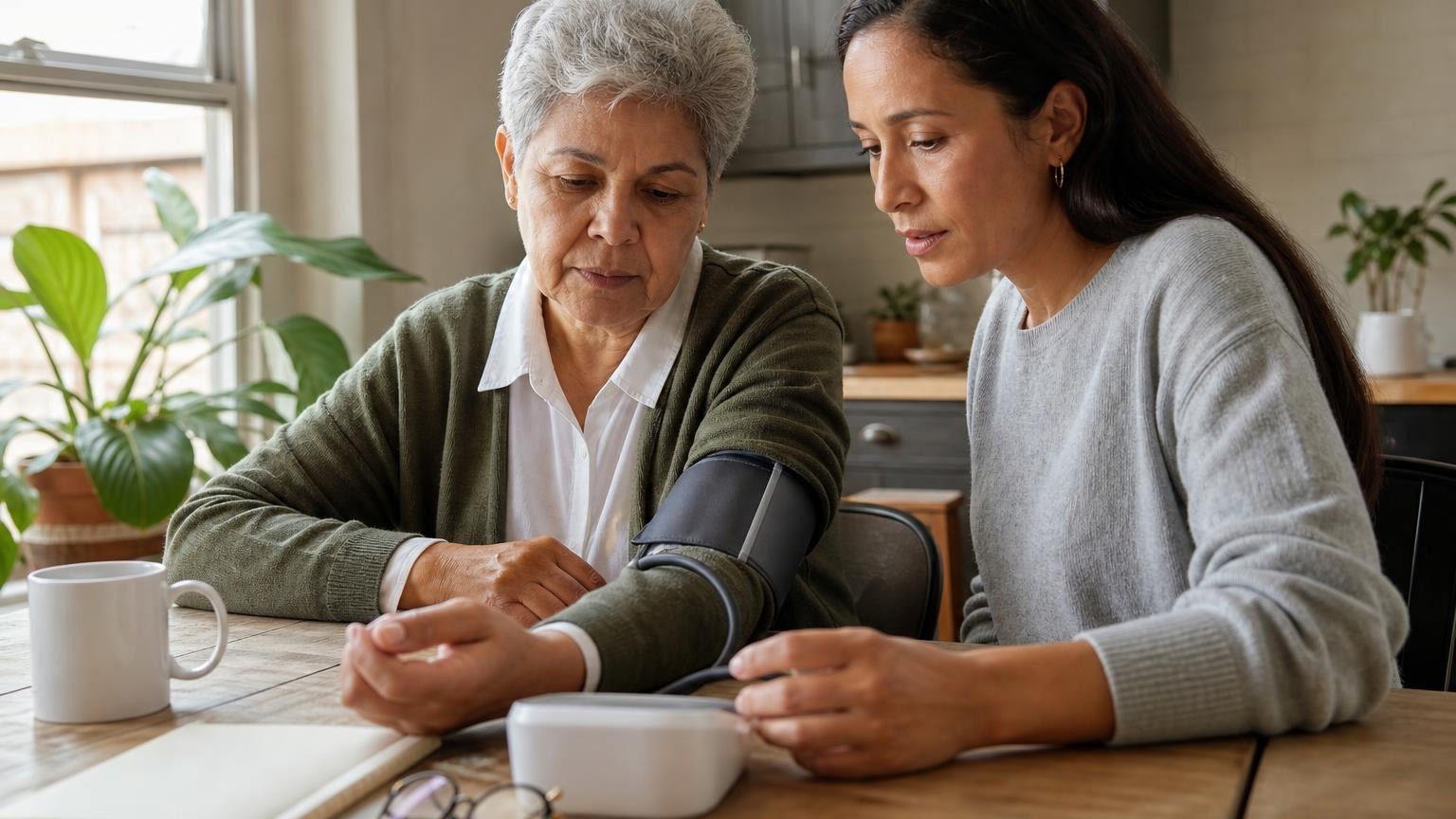
Knowing how to take someone else’s blood pressure at home is useful when you are helping a parent, partner, patient, or family member who has trouble placing the cuff, reading the screen, or keeping a steady routine. The goal is not to “do a medical exam.” The goal is to create a calm, repeatable setup so the numbers are worth logging.
The biggest mistake is treating the helper as a shortcut. If the person being measured is talking, sitting awkwardly, tense, unsupported, or wearing the cuff over clothing, the reading can still be noisy even if the helper presses every button correctly.
How to take someone else’s blood pressure: the short version
Use the same technique you would use for your own reading, but add one extra job: make the process quiet and consistent.
A good caregiver-style blood pressure check looks like this:
- Have the person use the bathroom first if needed.
- Seat them in a chair with back supported and feet flat.
- Let them rest quietly for about 5 minutes.
- Place the cuff on the bare upper arm, usually about one inch above the elbow bend.
- Support the cuffed arm on a table or pillow near heart level.
- Ask them not to talk, laugh, text, or move during the reading.
- Record the number, pulse, arm used, time, and any unusual context.
- If you are building a log, wait about one minute and take a second reading.
That routine sounds basic, but it prevents many of the errors that make home readings hard to interpret.
Set up the person, not just the monitor
When you help someone else measure blood pressure, your attention naturally goes to the device: cuff, tube, button, screen. But the person’s body position matters just as much.
Before you start, check four things:
- Chair: They should sit upright with their back supported, not perched on a bed edge or leaning forward.
- Feet: Both feet should be flat on the floor, legs uncrossed.
- Arm: The cuffed arm should rest on a table, pillow, or armrest rather than being held in the air.
- Mood: They should have a few quiet minutes before the reading, especially if they just climbed stairs, argued, rushed in, or felt anxious.
If the person is frail, dizzy, short of breath, or uncomfortable sitting upright, do not force the standard setup. Log the position used and ask a clinician what measurement routine they want. Readings taken lying down or from a nonstandard position should not be mixed casually with ordinary seated readings.
For a deeper posture check, see our guide to how to take an accurate blood pressure reading at home.
Put the cuff on their arm correctly
Cuff placement is where helpers can make or break the reading. You may be able to see details the person cannot: twisted fabric, a tube caught under the arm, a cuff sitting too low, or a sleeve bunched underneath.
Use this cuff checklist:
- place the cuff on bare skin, not over a sleeve
- position the lower edge about one inch above the elbow crease
- align the artery marker or tubing according to the monitor manual
- wrap it smoothly without wrinkles or folds
- make it snug enough to stay in place, but not painfully tight before inflation
- keep the tube relaxed, not pulled tight across the table
Do not guess cuff size. If the person has a very small or large upper arm, measure the upper-arm circumference and compare it with the cuff’s printed range. A cuff that fits you may not fit them. Our blood pressure cuff size chart explains how to measure the arm and match it to the cuff range.
If the cuff causes sharp pain, repeated bruising, numbness, swelling, or unusual skin changes, stop and get guidance instead of trying to push through more readings.
Keep the person quiet without making them nervous
The helper’s tone matters. If you hover, coach too much, or react strongly to the number, the person may tense up. That can make repeat readings less useful and can turn home monitoring into something they dread.
A calm script works better:
“Sit back, rest your arm here, and stay quiet until the cuff is done. We are just recording the number, not judging it.”
Avoid asking questions while the cuff is inflating. Do not tell them to “relax” repeatedly in a way that makes them more self-conscious. If they talk or move, wait a few minutes and repeat the reading rather than arguing over whether the number “counts.”
If the person is anxious about blood pressure, agree ahead of time how much detail they want. Some people prefer to hear every reading immediately. Others do better when the helper writes it down quietly and reviews the pattern later.
Take two readings, then log the context
For one casual check, a single reading may be enough to decide whether to keep an eye on things. For a home log that may be shared with a clinician, two readings are usually more useful than one isolated number.
A practical routine is:
- Take the first reading after the quiet rest period.
- Wait about one minute with the cuff still in place.
- Take a second reading.
- Record both readings, or record the average if the clinician asked for averages.
Do not take five or six readings in a row just because the numbers vary. Repeated cuff inflation can become uncomfortable, and chasing a “better” number can make the log less honest. If the first reading is much higher than expected, check posture, cuff fit, talking, pain, caffeine, exercise, and stress before assuming the monitor is wrong.
Write down:
- date and time
- systolic and diastolic numbers
- pulse if shown
- arm used
- seated, lying, or other position
- whether the reading was before or after medication, if relevant
- symptoms, caffeine, exercise, pain, stress, or illness when useful
A readable log is often more helpful than a device memory full of unlabeled readings.
When you should not be the person interpreting the result
Helping with measurement is not the same as diagnosing or deciding treatment. The helper can improve the setup, keep records, and notice patterns. Medication decisions, emergency decisions, and individualized targets belong with a qualified clinician.
Seek urgent medical help if a very high reading comes with concerning symptoms such as chest pain, severe shortness of breath, fainting, confusion, sudden weakness on one side, sudden vision changes, or a severe unusual headache. Do not spend time troubleshooting cuff position when symptoms suggest an emergency.
If readings are repeatedly high, unusually low, irregular, or very different from clinic readings, bring a clear log to the clinician. Do not adjust, skip, or retime medication based only on a home measurement unless the clinician has already given specific instructions.
Common mistakes when helping another person
Talking through the whole reading
It is natural to reassure someone, but conversation during the measurement can make the reading less clean. Do the setup first, then stay quiet while the cuff runs.
Holding their arm up for them
If you hold the person’s arm in the air, muscles can tense and the arm may drift away from heart level. Support the arm on a table, pillow, or armrest instead.
Using your own cuff without checking fit
Shared monitors can work, but only if the cuff fits each person and readings stay separate. If several people use one monitor, see our guide to sharing a blood pressure monitor at home.
Reacting dramatically to one number
A single number is a snapshot. Unless symptoms or clinician instructions say otherwise, the pattern across repeated, properly taken readings is usually more useful than one surprising result.
FAQ
Can I take someone else’s blood pressure with an automatic monitor?
Yes. An automatic upper-arm monitor is often the easiest option for helping another person at home. Your job is to place the cuff correctly, keep the arm supported, keep the person quiet, and record the context clearly.
Which arm should I use when taking someone else’s blood pressure?
Use the arm their clinician recommended if they gave specific instructions. If not, many people start by checking both arms on separate readings and then use the arm that the clinician or home routine identifies for ongoing tracking. Avoid arms with medical restrictions such as dialysis access, lymphedema risk, recent surgery, injury, or clinician instructions not to use that side.
Should I tell the person the number right away?
Usually yes, if they want to know. But if seeing each reading causes anxiety, agree on a calmer routine: write the number down, avoid dramatic reactions, and review the pattern later or with a clinician.
What if the person cannot sit in the standard position?
Use the safest comfortable position, log it clearly, and ask a clinician how they want readings taken. A lying-down or nonstandard-position reading can still be useful context, but it should not be treated as identical to a normal seated reading.
Bottom line
Taking someone else’s blood pressure at home is mostly about consistency: correct cuff size, bare upper arm, supported posture, a quiet rest period, no talking during inflation, and a clear log. A helper can make readings more reliable by making the routine calmer, not by rushing the process or interpreting every number alone.
This article is educational and not medical advice. Consult a qualified clinician before making treatment decisions, changing medication routines, or interpreting symptoms from home blood pressure readings.
Top 5 picks
Best Blood Pressure Monitors For Seniors 2026
Five upper-arm monitors ranked with published scorecards—setup friction, comfort, readability, power convenience, and repeatable accuracy—so you can compare models before you buy.
See our Top 5 blood pressure monitor picksHome-monitoring advice is only useful if it is easy to verify and act on correctly.
We write explainers to be understandable to readers, search engines, and AI answer systems.
Compare our Top 5 blood pressure monitor picks for 2026, then track readings over time with consistent technique.