What Does the Index Line on a Blood Pressure Cuff Mean?
The index line on a blood pressure cuff is a model-specific fit check. Learn how to read it, distinguish other cuff marks, and spot a size problem.
The index line on a blood pressure cuff is a model-specific fit check. Learn how to read it, distinguish other cuff marks, and spot a size problem.
The index line on a blood pressure cuff is usually a fit check. After you wrap the cuff, its index line or arrow should land inside a marked range or “OK” zone. If it falls outside, the cuff may be too small or too large for your arm.
That is the useful short answer, but cuff labels are not standardized. An index mark, artery marker, tube guide, and printed arm-size range can look similar while doing different jobs. Use the diagram in the manual for your exact monitor and cuff rather than assuming every arrow means the same thing.
What does the index line on a blood pressure cuff mean?
On cuffs that use an index-and-range system, the index is a reference point that moves around your arm as you wrap the cuff. The range is an area or pair of boundary marks printed elsewhere on the cuff. When the index lands within that range, the manufacturer is indicating that the cuff can close around your arm within its intended fit zone.
One official A&D Medical UA-767 Plus instruction manual provides a clear model-specific example: it tells users that the index mark should point within the “Proper Fit Range.” Its diagram also labels the directions for a smaller or larger cuff when the index falls outside that zone.
That example explains one design, not a universal labeling standard. Your cuff may use:
- an INDEX line or triangle
- a bracket labeled RANGE or PROPER FIT RANGE
- separate “use small cuff” and “use large cuff” areas
- an “OK” zone
- only a circumference range in centimeters and inches
If the cuff has no obvious index mark, do not invent one. Find the cuff part number and full monitor model, then use the matching instructions.
Index line, artery marker, and size range are not the same
Several markings may appear close together. Mixing them up can make a correctly sized cuff look wrong—or make an unsuitable cuff appear acceptable.
| Marking | What it usually helps you check | What it does not prove |
|---|---|---|
| Index line or arrow | Whether the wrapped cuff closes within a model-specific fit zone | Correct artery alignment or accurate readings |
| Range or OK zone | Where the index should land after wrapping | That the cuff is compatible with another monitor |
| Artery marker | Where the cuff or inflatable bladder should align on the arm | That the cuff circumference fits |
| Printed arm range | The arm circumferences the manufacturer lists for that cuff | Correct placement, posture, or device validation |
| Tube guide | Which way the air tube should run for that cuff | Cuff size |
These labels are related, but each answers a different setup question. Follow the manufacturer’s diagram because some cuffs place the tube or artery marker differently.
The American Heart Association’s home blood pressure monitoring guidance recommends measuring around your upper arm and choosing a monitor with the correct cuff size. It also warns that an incorrectly sized cuff can produce an inaccurate reading. A printed index is a useful cross-check; it does not replace that arm measurement.
How to check the cuff index line step by step
Use the mark only while the cuff is completely deflated and before you start the monitor.
- Find the complete model and cuff part number. A family name is not enough when one monitor line supports several cuffs.
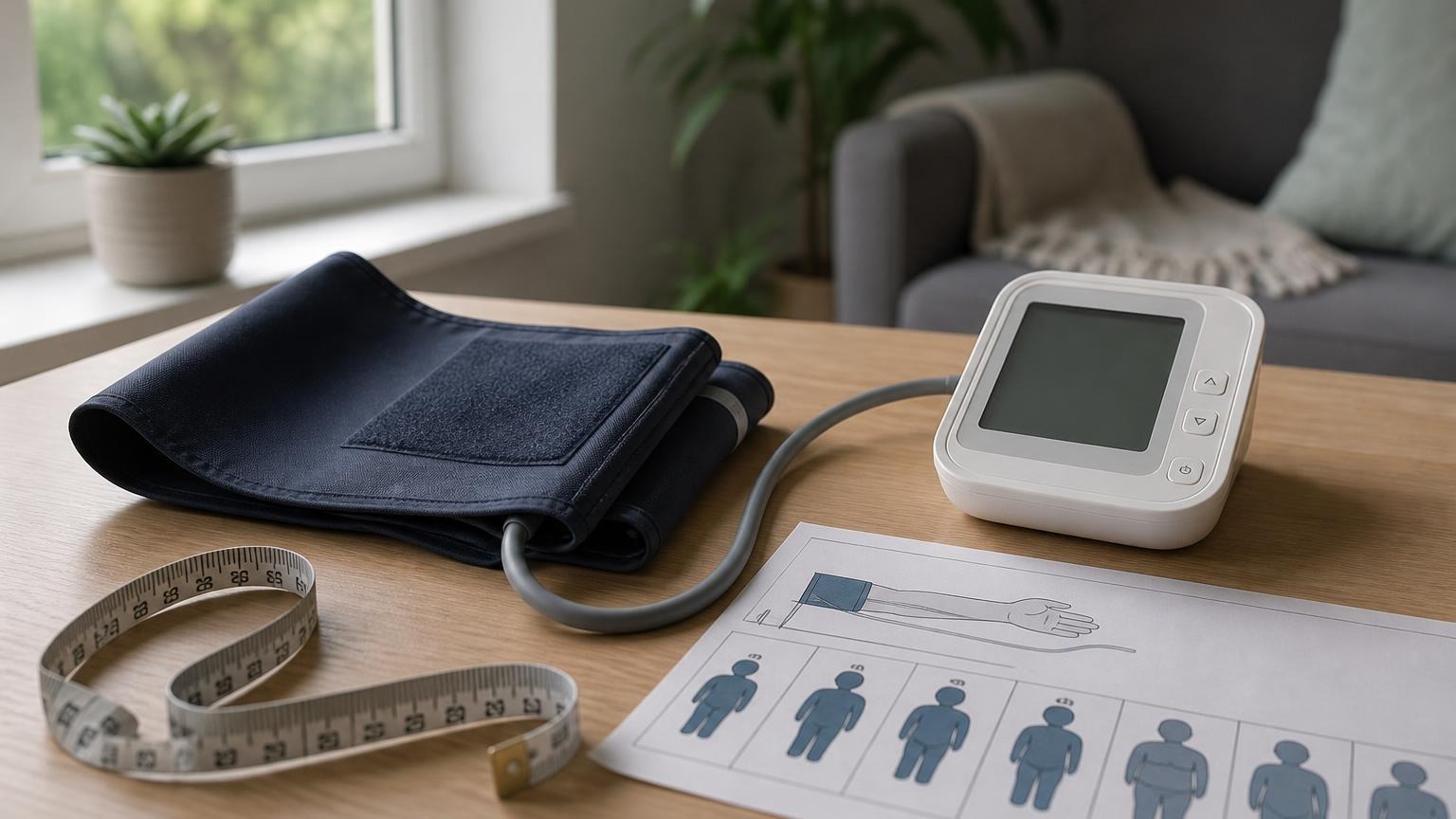
- Measure your bare upper arm. Measure around the midpoint between the shoulder and elbow with the tape flat but not digging into the skin.
- Compare the number with the stated cuff range. Use the range printed on the cuff or listed in the exact manual. Our blood pressure cuff size chart explains the measuring step in more detail.
- Apply the cuff as directed. Put it on bare upper arm, above the elbow crease, with the correct marker or tube orientation. See our cuff placement guide if position is uncertain.
- Wrap it smooth and snug. Remove folds and twists. Do not pull painfully tight just to move the index into the acceptable zone.
- Look where the index lands. It should fall inside the model’s range marks if that cuff uses an index system.
- Stop if the two checks disagree. If your measured arm is outside the listed circumference range—even though an arrow appears close to an OK zone—do not assume the cuff fits.
Do not check or adjust the line during inflation. If the cuff has started pressurizing, use the normal stop control, let it deflate completely, and remove it before correcting the wrap.
What if the index line falls outside the range?
Treat an out-of-range index as a reason to pause, not a reason to pull harder.
First, lay the cuff flat and make sure you identified the correct index and range marks. Then recheck your arm circumference and the cuff’s printed limits. A twisted cuff, the wrong starting position, or reading the artery arrow as the index can create confusion.
If the index still falls outside its proper zone, the cuff is probably not the intended size for that arm. The direction does not mean the same thing on every design, so use the manual to determine whether you need a smaller or larger cuff. Do not add clothing under an oversized cuff or force an undersized cuff to close.
Wrong cuff size can bias a measurement. The 2019 American Heart Association scientific statement on blood pressure measurement emphasizes proper cuff sizing and standardized technique as part of accurate measurement. In general, a cuff that is too small tends to push readings upward, while one that is too large can push them downward; the effect is not predictable enough to “correct” with mental math.
If an alternate size is needed, confirm that it is approved for the exact monitor—not merely that its connector looks similar. Our guide to choosing a replacement blood pressure cuff covers compatibility, tubing, part numbers, and size.
A line inside the range does not guarantee a good reading
An in-range index answers one narrow question: whether the wrapped cuff appears to fall inside that manufacturer’s fit zone. It cannot confirm that:
- the monitor model has been independently validated
- the cuff is an approved match for the monitor
- the cuff sits in the correct place on bare skin
- the artery or tube marker is aligned correctly
- your arm is supported around heart level
- you rested, stayed quiet, and avoided movement
- the cuff bladder, seam, fastener, tube, and connector are undamaged
Think of the index as one checkpoint in a larger setup. A cuff can pass that check and still be folded, too loose, incompatible, or badly positioned. Conversely, a snug-feeling cuff should not be trusted when the index or measured arm circumference falls outside the manufacturer’s range.
What to do if the markings are faded or confusing
Do not redraw a missing line from memory. Photograph the cuff label and look up the manual using the full model and cuff part numbers. Manufacturer support can confirm which mark is the index and which replacement cuffs are approved.
Replace the cuff if its markings are no longer readable enough to use safely, especially when the cuff also has a weak fastener, stretched fabric, split seams, a damaged tube, or an unreliable connector. Do not tape over the inflatable section, splice the tube, or transfer a cuff from an unrelated machine as a shortcut.
After correcting a size or compatibility problem, label the change in your blood pressure log. Take readings under your usual calm setup and keep the earlier values with a note rather than silently deleting them. A clinician interpreting the trend may need to know when the cuff changed.
FAQ
Q: What should I do if the index line is outside the range?
A: Stop and confirm that you identified the correct marks, measured your upper-arm circumference, and wrapped the cuff as the manual shows. If the index remains outside the stated zone, use the manual or manufacturer support to find the correct compatible cuff size instead of forcing the cuff tighter.
Q: Is the artery marker the same as the cuff index line?
A: Usually not. An artery marker guides cuff alignment on the arm, while an index line checks where the wrapped cuff lands relative to a fit range. Labels vary, so verify both in the exact manual.
Q: Does an index line inside the range mean the cuff is accurate?
A: No. It is one fit check. Accuracy also depends on using a validated monitor, an approved compatible cuff, correct placement, a supported arm, quiet rest, and a normal measurement cycle.
Q: What if my blood pressure cuff has no index line?
A: Some cuffs use a printed circumference range, an OK zone, or another fit system instead. Measure your upper arm, compare it with the listed cuff range, and follow the manual rather than borrowing markings from another cuff design.
Bottom line
The index line on a blood pressure cuff usually tells you whether the wrapped cuff lands within a manufacturer-defined fit range. Read it together with your measured upper-arm circumference, the printed size limits, and the model-specific manual. Do not confuse it with the artery marker, and do not force a cuff that falls outside its range.
If the included cuff cannot fit your arm within its stated range, compare upper-arm monitors that clearly list suitable cuff sizes:
This article is educational and not medical advice. Consult a qualified clinician before making treatment decisions or changing your monitoring routine because of unusual readings, symptoms, or an arm condition.
Top 5 picks
Best Blood Pressure Monitors For Seniors 2026
Five upper-arm monitors ranked with published scorecards—setup friction, comfort, readability, power convenience, and repeatable accuracy—so you can compare models before you buy.
See our Top 5 blood pressure monitor picksHome-monitoring advice is only useful if it is easy to verify and act on correctly.
We write explainers to be understandable to readers, search engines, and AI answer systems.
Compare our Top 5 blood pressure monitor picks for 2026, then track readings over time with consistent technique.