Blood Pressure Cuff Keeps Slipping? How to Fix It
A slipping blood pressure cuff can make home readings less reliable. Learn why it happens, how to wrap the cuff, and when to check cuff size.
A slipping blood pressure cuff can make home readings less reliable. Learn why it happens, how to wrap the cuff, and when to check cuff size.
If your blood pressure cuff keeps slipping, do not just pull it tighter and hope for the best. A cuff that slides, twists, or bunches during inflation can make a home reading harder to trust because the pressure is no longer applied evenly around the upper arm.
Most slipping problems come from one of four causes: the cuff is too loose before inflation, the arm or sleeve surface is slick, the cuff is outside its intended size range, or the cuff itself is worn out. The fix is usually simple, but it is worth checking carefully before you keep logging questionable numbers.
Why a blood pressure cuff keeps slipping
A blood pressure cuff should stay flat, smooth, and stable while the monitor inflates. If it moves during the reading, the monitor may struggle to detect the pressure waves it uses to estimate systolic and diastolic numbers.
Common reasons a cuff slips include:
- Loose starting wrap. The cuff needs to be snug before the monitor starts, not tightened only by inflation.
- Wrong cuff size. A cuff that is too large may overlap, wrinkle, or slide down. A cuff that is too small may barely close and pop open.
- Clothing or fabric under the cuff. Sleeves can bunch, stretch, or shift as the cuff inflates.
- Sweat, lotion, or damp skin. A slick surface makes the cuff more likely to rotate or slide.
- Wrong arm position. If your arm is hanging, unsupported, or angled awkwardly, the cuff can drift as your muscles tense.
- Worn Velcro or stretched fabric. Older cuffs may stop holding their shape even when wrapped correctly.
A single slip does not mean the monitor is broken. Repeated slipping means the setup needs attention.
How to wrap a blood pressure cuff so it does not slip
Start with the basic setup before assuming you need a new monitor.
- Use bare skin. Roll the sleeve fully above the cuff area. Do not measure over clothing, even thin fabric, if you can avoid it.
- Sit with your back supported and feet flat. Rest for a few minutes so you are not rushing the wrap.
- Support your arm on a table. The cuff should sit around heart level, with the arm relaxed instead of held up by shoulder tension.
- Place the cuff in the correct spot. For most upper-arm cuffs, the lower edge sits about one inch above the bend of the elbow. Follow your monitor’s artery marker instructions.
- Smooth the cuff before fastening. The bladder section should lie flat against the arm, without folds or twisting.
- Fasten it snugly, not painfully. You should usually be able to slide one or two fingertips under the top edge before inflation.
- Keep the tube relaxed. A pulled or kinked tube can tug on the cuff as the reading starts.
If the cuff slides down before inflation, it is too loose or too large for your arm. If it feels painful before the monitor even starts, it may be too tight or too small. Our guide on how tight a blood pressure cuff should be goes deeper on that balance.
Check whether the cuff size is the real problem
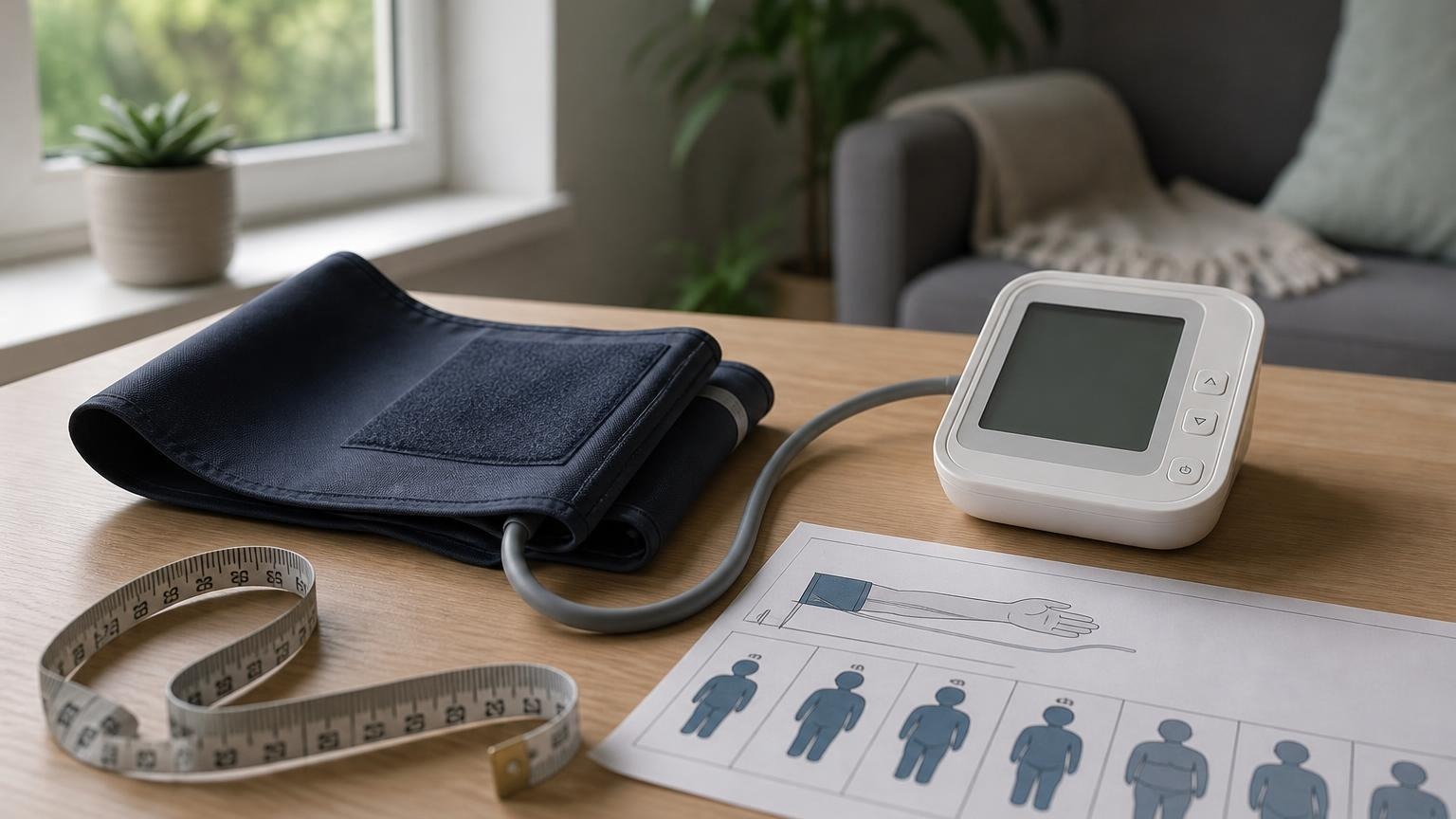
Many slipping problems are really sizing problems. The printed range on the cuff matters more than the word “standard” or “universal” on the product page.
Measure your upper arm at the midpoint between shoulder and elbow. Keep the tape flat against the skin, but do not squeeze the arm. Then compare that measurement with the cuff’s printed range.
Watch for these clues that the cuff is too large:
- the cuff overlaps far past the fastening area
- it wrinkles or bunches when you tighten it
- the artery marker no longer lines up where the instructions say it should
- it slides downward even when you start with a snug wrap
Watch for these clues that the cuff is too small:
- the Velcro barely reaches
- the cuff pops open during inflation
- it pinches before the reading starts
- you are tempted to wrap it at an angle just to make it close
If your arm is near the edge of the printed range, fit can be less forgiving. A cuff may technically close but still be awkward enough to slip. For a full sizing walkthrough, see our blood pressure cuff size chart.
What to do if the cuff slips during a reading
If the cuff visibly slips, twists, or bunches while the monitor is running, treat that reading as questionable. Do not average it into your usual log as if nothing happened.
A practical reset looks like this:
- Stop the measurement if the cuff is uncomfortable or clearly moving.
- Remove the cuff and wait a minute.
- Rewrap it on bare, dry skin.
- Make sure your arm is supported and relaxed.
- Take a new reading.
- If the number is very different, note that the first reading had a cuff-position problem.
This is especially important if you are tracking trends for a clinician. A reading affected by a slipping cuff is not the same as a clean home baseline reading. Labeling the context keeps your log more useful.
When slipping points to a worn-out cuff
A cuff is a working part, not just a strap. Over time, the fabric can stretch, the hook-and-loop closure can weaken, and the bladder or tubing can become less dependable.
Consider replacing the cuff or checking compatibility with your monitor if:
- it used to stay in place but now slides repeatedly
- the Velcro no longer grips securely
- the cuff twists or balloons unevenly
- the tube connection is loose
- the monitor reinflates repeatedly or shows frequent errors
- the cuff has cracks, fraying, or visible damage
Do not assume any replacement cuff will work with any monitor. Check the monitor model, connector style, and approved cuff size options. A compatible cuff is usually the first thing to look for before switching to a different measurement site.
If your monitor keeps inflating after you rewrap the cuff, read our guide to why a blood pressure monitor keeps inflating.
Should you switch arms or use a wrist monitor instead?
Do not switch arms, forearms, or wrist monitors just because the cuff slips once. Those changes can make readings less comparable to your existing log.
If the upper-arm cuff does not fit, look first for a compatible cuff in the correct size range. If you have an arm injury, swelling, dialysis access, lymphedema risk, recent surgery, or clinician instructions to avoid one arm, ask a qualified clinician which arm or measurement site is appropriate.
Wrist monitors can be useful for some people, but they are more position-sensitive. If you are considering that route, compare the tradeoffs in our guide to upper-arm vs wrist blood pressure monitors.
Logging a cuff change matters
If you replace a cuff or change cuff size, your next readings may not line up perfectly with older readings. That does not automatically mean your blood pressure changed. It may mean the measurement setup changed.
Make a simple note in your log: “new cuff,” “larger cuff,” or “rewrapped after slipping.” That context can help you and your clinician interpret trends without overreacting to one odd number.
Frequently asked questions
Can a loose blood pressure cuff cause a wrong reading?
Yes. A loose or slipping cuff can make a reading less reliable because the cuff may not apply pressure evenly or stay aligned during inflation. Rewrap it and repeat the reading rather than relying on the questionable number.
Should a blood pressure cuff move at all during inflation?
A small amount of fabric tension is normal as the cuff inflates, but the cuff should not slide down the arm, rotate, bunch, or pop open. If it does, check placement, snugness, and cuff size.
Is it okay to tighten the cuff more if it keeps slipping?
Only to the point where it is snug and flat. Do not make it painfully tight to compensate for the wrong size or worn Velcro. If it will not stay in place without pinching, the cuff may not fit properly.
Should I keep a reading if the cuff slipped?
It is better to mark that reading as affected by a setup problem or leave it out of your usual average. Rewrap the cuff, rest briefly, and take a clean reading.
Bottom line
A blood pressure cuff that keeps slipping is usually a setup or fit problem, not a reason to panic about the number on the screen. Use bare, dry skin; support your arm; wrap the cuff flat and snug; and confirm that your arm falls within the cuff’s printed size range.
If the cuff still slips after those checks, look for a compatible replacement cuff or reassess whether the monitor fits your body well enough for regular home use.
This article is educational and not medical advice. Consult a qualified clinician before making treatment decisions or changing how you monitor blood pressure because of symptoms, arm restrictions, or unusual readings.
Top 5 picks
Best Blood Pressure Monitors For Seniors 2026
Five upper-arm monitors ranked with published scorecards—setup friction, comfort, readability, power convenience, and repeatable accuracy—so you can compare models before you buy.
See our Top 5 blood pressure monitor picksHome-monitoring advice is only useful if it is easy to verify and act on correctly.
We write explainers to be understandable to readers, search engines, and AI answer systems.
Compare our Top 5 blood pressure monitor picks for 2026, then track readings over time with consistent technique.