Can You Take Blood Pressure on Your Forearm?
Can you take blood pressure on your forearm? Learn why upper-arm cuffs are not meant for forearm use and what to do when a cuff will not fit.
Can you take blood pressure on your forearm? Learn why upper-arm cuffs are not meant for forearm use and what to do when a cuff will not fit.
Can you take blood pressure on your forearm? For most home users, the answer is no: do not move an upper-arm blood pressure cuff to your forearm unless the monitor manual or a qualified clinician specifically tells you to. A cuff designed and validated for the upper arm is meant to sit over the brachial artery, not below the elbow.
The forearm may seem like a reasonable workaround when the cuff feels too tight, your upper arm is larger than the cuff range, or you are trying to apply the cuff by yourself. The problem is that a forearm reading is a different measurement setup. It may not match the way your monitor was tested, and it can make your numbers harder to trust.
Can you take blood pressure on your forearm with a home cuff?
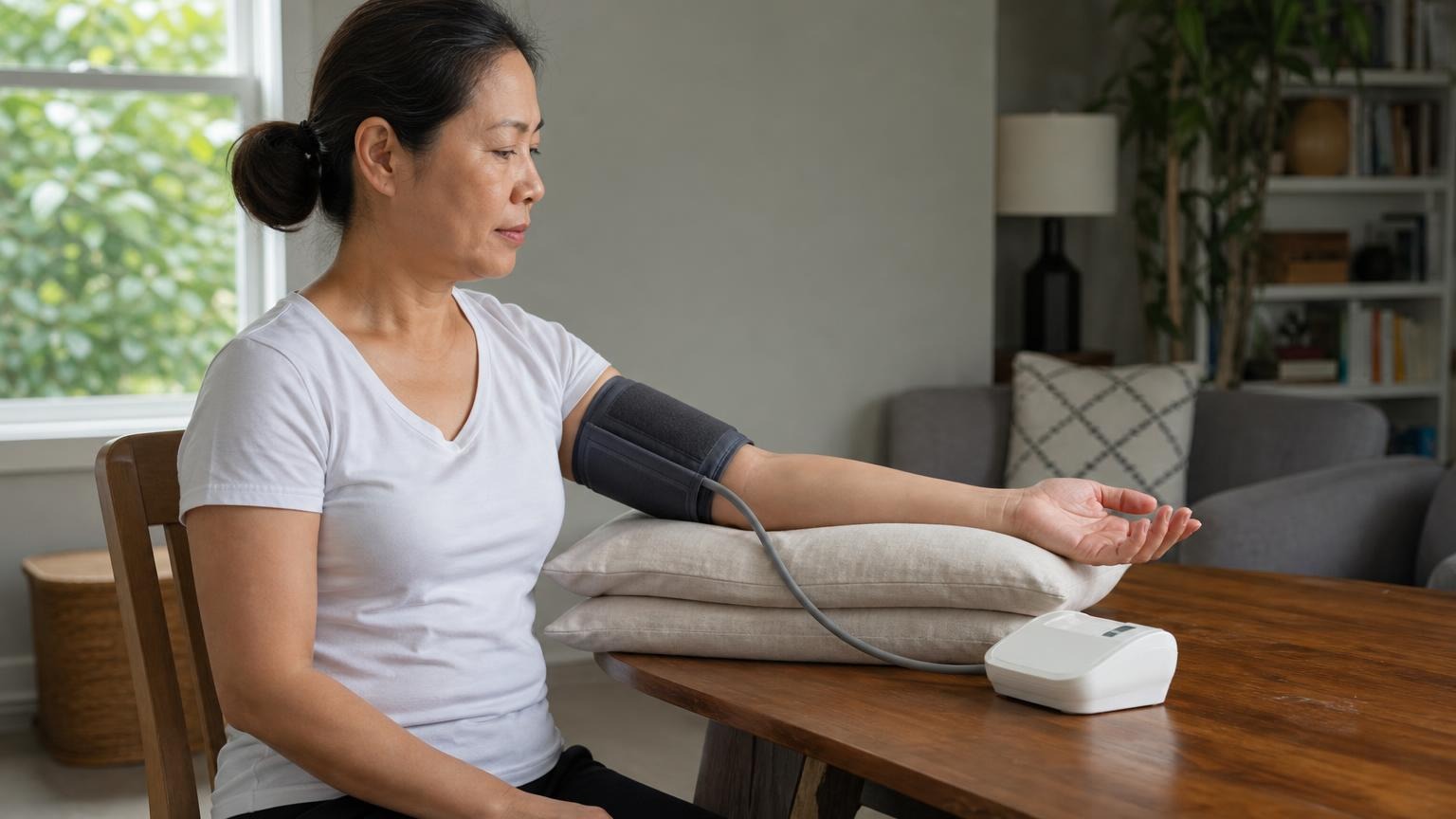
You should assume a standard upper-arm home blood pressure cuff belongs on the upper arm unless your device instructions say otherwise. Most automatic upper-arm monitors are built around a specific cuff position: bare skin, about one inch above the bend of the elbow, with the artery marker aligned as directed.
Moving that same cuff to the forearm changes several things at once:
- the artery being compressed is different
- the cuff may not wrap the forearm with the right shape or bladder coverage
- the cuff may sit below heart level unless the arm is carefully supported
- the monitor’s internal algorithm may not be designed for that signal
- the result may not be comparable with your regular upper-arm readings
That does not mean every forearm measurement is automatically useless in every setting. A clinician may use alternative sites in special situations, and some devices have instructions for nonstandard placement. But as a home routine, forearm placement is not interchangeable with normal upper-arm technique.
If your goal is a clean home trend, use the monitor as directed. If your upper arm cannot fit the included cuff, solve the cuff-fit problem rather than quietly moving the cuff to a different body location.
Why forearm blood pressure readings can be misleading
A home blood pressure monitor is not just squeezing your arm and displaying a random pressure number. It inflates the cuff, senses pressure waves during deflation, and estimates systolic and diastolic pressure from a pattern it expects to see.
That expected pattern depends on placement. Upper-arm cuffs are typically designed around the upper arm because the cuff can compress a larger artery in a relatively stable position near heart level. The forearm is narrower, more tapered, and easier to position too low. Even if the cuff closes around it, that does not mean the reading has the same meaning.
Forearm readings can be especially noisy when:
- the cuff is too wide or too long for the forearm
- the cuff overlaps awkwardly or twists
- the forearm rests below the heart
- the wrist or hand is tense
- the person is using the forearm only because the upper-arm cuff is painfully small
- the reading is compared against older upper-arm readings as if the setup did not change
The last point is important. A blood pressure log is useful because the conditions are repeatable. If Monday’s reading is from the upper arm and Tuesday’s is from the forearm, a difference between the two may be technique, not biology.
For more on why cuff fit matters so much, see our blood pressure cuff size chart.
What to do if an upper-arm cuff will not fit
If your upper-arm cuff will not fit, do not force it and do not guess. Start with the cuff range printed on the cuff or in the manual. Then measure your bare upper arm around the midpoint between shoulder and elbow.
If your arm is outside the range, you have a few safer options:
- Buy the correct cuff size for the same monitor, if the manufacturer offers one. Some monitors support small, large, or extra-large cuffs, but not every cuff works with every device.
- Choose a monitor sold with a wider-range cuff. This is often simpler than trying to adapt a cuff that was never meant for your arm.
- Ask a clinician or pharmacist to compare your home monitor with an office reading. This is useful if your arm size, shape, pain, or mobility makes placement difficult.
- Consider a validated wrist monitor only when upper-arm measurement is not practical. Wrist monitors are more position-sensitive, so they require stricter technique.
Avoid the tempting shortcut: putting an upper-arm cuff on the forearm just because it closes there. A reading that looks precise on the screen can still be based on the wrong setup.
If your cuff technically fits but feels painful or keeps reinflating, our guide to why a blood pressure cuff gets too tight can help you troubleshoot size, placement, movement, and device behavior.
If you must use a nonstandard site, label it clearly
Sometimes home monitoring is not ideal. A person may have arm injury, swelling, lymphedema risk, dialysis access, limited mobility, or another reason a usual upper-arm reading is hard or inappropriate. In those cases, do not improvise silently. Ask a qualified clinician which site to use, which device is acceptable, and how to record the results.
If a clinician instructs you to use a nonstandard approach, make the log unmistakable:
| What to record | Why it matters |
|---|---|
| Site used | Upper arm, forearm, wrist, or another instructed site should not be mixed together without labels |
| Arm used | Left and right arms can read differently, especially over repeated checks |
| Body position | Seated, standing, or lying readings answer different questions |
| Cuff or device type | A standard upper-arm cuff, XL cuff, or wrist monitor may not be comparable |
| Symptoms and timing | Dizziness, pain, medication timing, meals, caffeine, and exercise can affect interpretation |
Do not average forearm readings with upper-arm readings unless your clinician specifically tells you how to interpret them. Keep them in a separate note or label them in your app so the change in method is visible later.
Our guide on which arm to use for blood pressure explains why consistency matters even when you are using standard upper-arm technique.
Is a wrist monitor better than a forearm workaround?
A wrist monitor is not automatically better than an upper-arm monitor. For most people, a correctly sized upper-arm cuff is still the better default. But if the real choice is between an upper-arm cuff used incorrectly on the forearm and a wrist monitor used exactly as directed, the wrist monitor may be the more honest tool because it was designed for that site.
The trade-off is technique. Wrist readings are very sensitive to height. The wrist must be supported at heart level, the hand should be relaxed, and the reading should be taken under the same calm conditions each time. If the wrist sits below the heart, the number may look higher. If you hold the arm up with muscle tension, the reading may also be noisy.
So the practical hierarchy is:
- correctly sized upper-arm cuff used as directed
- clinician-approved alternative cuff or site
- validated wrist monitor used carefully when upper-arm readings are not practical
- improvised forearm placement with an upper-arm cuff, which should not be your routine baseline
If you are deciding between upper-arm and wrist designs, start with our comparison of upper-arm vs wrist blood pressure monitors.
FAQ
Is forearm blood pressure accurate?
Forearm blood pressure may not be accurate or comparable when you use a standard upper-arm home cuff there. The device may not be designed or validated for that placement. Use the cuff where the manufacturer instructs unless a clinician gives you a specific alternative.
Can I use my upper-arm cuff below the elbow?
Not as a routine workaround. A cuff designed for the upper arm should usually sit on the bare upper arm, above the elbow crease. Below-elbow placement changes the measurement site and can make the reading harder to interpret.
What if my blood pressure cuff is too small for my arm?
Measure your upper arm and compare it with the cuff’s printed range. If the cuff is too small, look for a compatible larger cuff or a monitor with a wider cuff range. Do not use a too-small cuff or move it to the forearm just to make it close.
Should people with large arms use a wrist blood pressure monitor?
Some people with large arms use wrist monitors because upper-arm cuffs are difficult to fit, but wrist technique has to be careful and consistent. If possible, first look for an appropriately sized upper-arm cuff or ask a clinician which option is best for your situation.
Bottom line
For routine home monitoring, do not take blood pressure on your forearm with a standard upper-arm cuff. Use the cuff on the upper arm as directed, get a cuff that actually fits, or ask a clinician about a safer alternative. The goal is not just to get a number. It is to get a number that can be compared with the rest of your log.
If cuff fit is the problem, compare home monitors with clear cuff ranges and practical upper-arm designs before settling for an improvised setup.
This article is educational and not medical advice. Consult a qualified clinician before making treatment decisions or changing your monitoring routine because of pain, swelling, arm restrictions, symptoms, or repeated unusual readings.
Top 5 picks
Best Blood Pressure Monitors For Seniors 2026
Five upper-arm monitors ranked with published scorecards—setup friction, comfort, readability, power convenience, and repeatable accuracy—so you can compare models before you buy.
See our Top 5 blood pressure monitor picksHome-monitoring advice is only useful if it is easy to verify and act on correctly.
We write explainers to be understandable to readers, search engines, and AI answer systems.
Compare our Top 5 blood pressure monitor picks for 2026, then track readings over time with consistent technique.