Should You Take Blood Pressure Sitting or Lying Down?
Should you take blood pressure sitting or lying down? Learn which posture works best at home, when lying readings matter, and how to log them.
Should you take blood pressure sitting or lying down? Learn which posture works best at home, when lying readings matter, and how to log them.
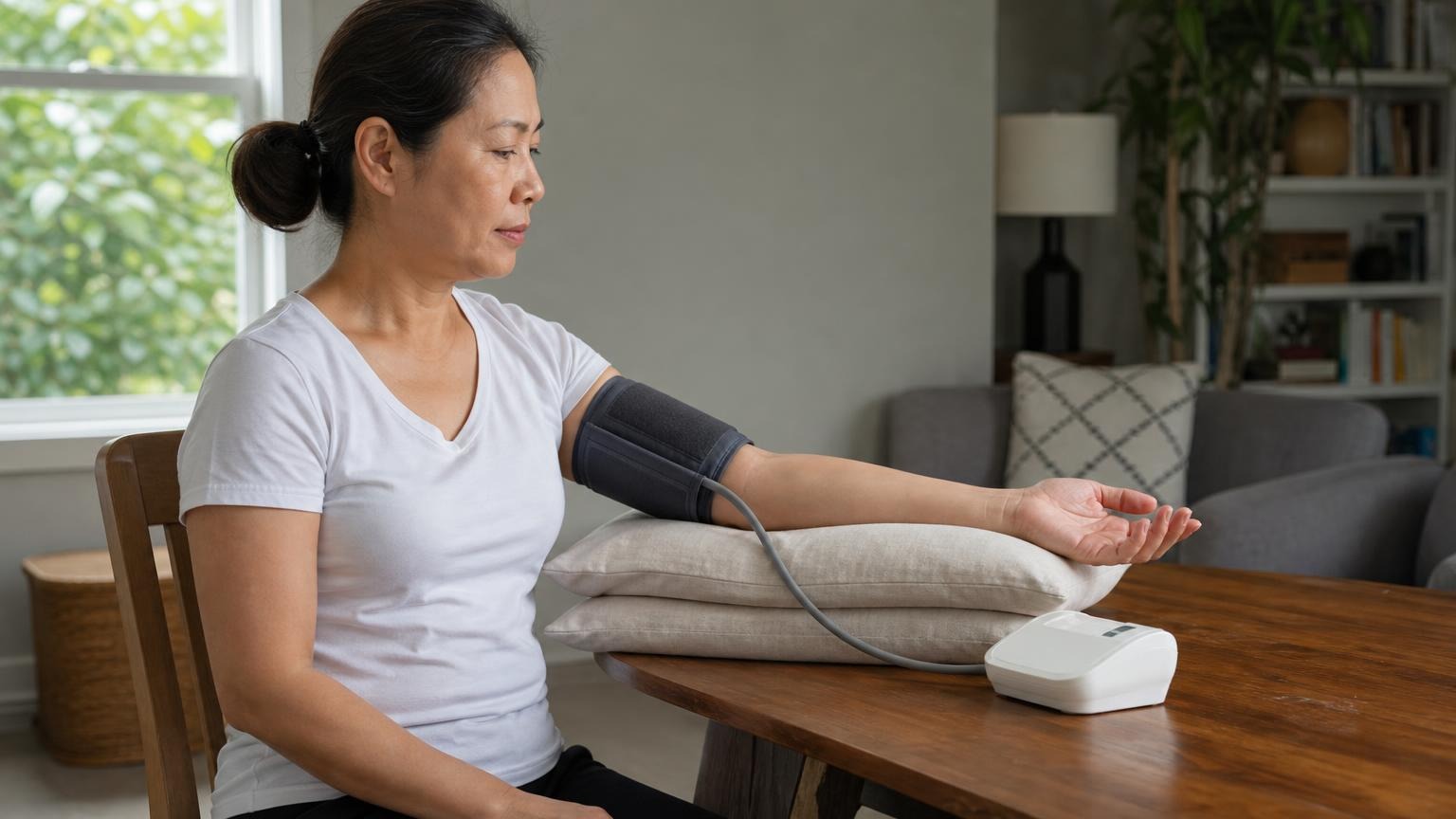
Should you take blood pressure sitting or lying down? For routine home monitoring, the best default is sitting in a chair with your back supported, feet flat, and arm supported at heart level. That is the position most home instructions, clinic comparisons, and blood pressure logs are built around.
Lying down is not wrong, but it answers a different question. A lying reading can be useful if you are checking dizziness, comparing position changes, or following a clinician’s instructions. It is less useful when it gets mixed into a regular seated log without a clear label.
Should you take blood pressure sitting or lying down at home?
Use a seated position for your usual home blood pressure routine unless your clinician told you otherwise.
A clean seated setup is repeatable:
- sit in a chair, not on the edge of a bed
- support your back
- keep both feet flat and legs uncrossed
- rest for 5 minutes before measuring
- place the cuff on bare upper arm
- support your forearm so the cuff is at heart level
- take two readings about one minute apart and record the average
That consistency matters more than chasing the posture that gives the lowest number. If Monday’s reading is seated at the kitchen table, Tuesday’s is lying in bed, and Wednesday’s is standing after a shower, the trend becomes harder to interpret.
For the full setup checklist, start with our guide to taking an accurate blood pressure reading at home.
Why posture changes blood pressure readings
Blood pressure is sensitive to position because gravity changes how blood returns to the heart and how hard the body has to work to maintain circulation.
When you sit upright, your cardiovascular system is balancing blood flow to the brain, arms, legs, and trunk against gravity. When you lie flat, that gravitational load changes. Some people may see slightly different systolic or diastolic numbers in a lying position even when the cuff is placed correctly.
The difference is not automatically a sign that one reading is “true” and the other is “wrong.” It usually means the two readings were taken under different conditions.
Small posture details can also distort the result:
- Arm below heart level can make the reading look higher.
- Arm above heart level can make the reading look lower.
- Unsupported back or feet can raise the number for some people.
- Tensing your arm or shoulder can add measurement noise.
- Talking or scrolling your phone can turn a resting reading into an activity reading.
This is why posture advice can sound fussy. Home monitors are measuring a moving biological system, not a fixed number.
When a lying blood pressure reading can be useful
A lying reading may be useful when position itself is part of the question. For example, a clinician may ask for lying, sitting, and standing readings if you feel lightheaded when you get up. That pattern can help show whether blood pressure drops with position change.
A lying reading may also be practical when:
- you are recovering from illness and cannot sit comfortably
- you have mobility limits that make a chair setup difficult
- your clinician specifically asked for supine readings
- you are comparing symptoms that happen in bed or when standing up
If you take a lying reading, make it as controlled as possible. Lie quietly for several minutes first. Keep the cuff on bare upper arm. Support the arm so the cuff is level with the middle of your chest, not down by your hip or raised above your shoulder.
Most importantly, label it clearly in your log: “lying down,” “seated,” or “standing.” A clinician can interpret a position-specific pattern only if the position is written down.
Do not mix sitting and lying readings casually
The main mistake is not taking a lying reading. The mistake is mixing positions without context.
A blood pressure log should make patterns easier to see. If the numbers jump around because the position changes every time, the log may look more dramatic than your actual baseline.
Use this simple rule:
| Situation | Best approach |
|---|---|
| Routine morning or evening tracking | Use seated readings consistently |
| Comparing symptoms when standing up | Follow a clinician-directed lying/sitting/standing sequence |
| Too weak or uncomfortable to sit | Take a lying reading and label it clearly |
| One high reading in bed | Repeat later with your usual seated technique if you feel well enough |
If you are building a baseline for a routine appointment, a week of consistent seated readings usually tells a cleaner story than scattered readings from several postures. Our article on how many blood pressure readings to take explains how repeated readings and averages reduce noise.
How to take a lying blood pressure reading correctly
If you need a lying reading, use a repeatable method:
- Lie flat or slightly reclined in the same position each time.
- Rest quietly for 5 minutes before starting.
- Keep the cuff on bare upper arm.
- Support the arm with a pillow if needed so the cuff is at heart level.
- Keep the palm relaxed and the arm still.
- Take two readings about one minute apart.
- Record the average and write “lying down” in the notes.
Do not compare a lying reading taken after 10 quiet minutes with a seated reading taken immediately after walking upstairs. If you are comparing positions, keep everything else as similar as possible: same monitor, same arm, same cuff, same time window, same quiet rest period.
For arm-height details, see how to position your arm for a blood pressure reading.
What if sitting and lying readings are very different?
A small difference between sitting and lying readings is not unusual. A large or repeated difference is worth documenting rather than guessing about.
Write down:
- the exact numbers
- the position for each reading
- whether you had dizziness, weakness, fainting, chest pain, shortness of breath, or unusual fatigue
- whether the readings were taken before or after medication
- whether you had recently eaten, exercised, showered, or had caffeine
If the difference keeps repeating, bring the pattern to a qualified clinician. Do not change medication timing, skip doses, or self-diagnose from position-based readings. Home measurements are useful because they add context, but context still needs clinical interpretation when symptoms or large changes are involved.
If you are trying to understand a longer record, our guide to reading a blood pressure log explains which patterns are worth summarizing.
FAQ
Is blood pressure higher sitting or lying down?
It depends on the person, the setup, and the reason for measuring. Some people see slightly different readings when lying down because body position changes circulation and arm height. For routine tracking, consistency matters more than choosing the posture that gives a lower number.
Can I take blood pressure lying in bed?
You can if you cannot sit comfortably or your clinician asked for it. Keep your arm supported at heart level, rest quietly first, and label the reading as lying down. For a normal home baseline, a seated chair setup is usually easier to compare over time.
Should I take blood pressure standing up?
Standing readings are usually taken for a specific reason, such as checking symptoms when you stand. They should be done carefully and labeled clearly. Do not replace your routine seated readings with standing readings unless your clinician told you to.
Which position should I use for my blood pressure log?
For most home logs, use seated readings at the same time of day, with the same arm and technique. Add lying or standing readings only when they answer a specific question, and write the position in your notes.
Bottom line
For everyday home monitoring, take blood pressure sitting in a supported chair with your arm at heart level. Lying down can be useful in specific situations, but it should be labeled and kept separate from your usual seated trend.
If you need a home monitor that makes consistent tracking easier, start with our evidence-minded roundup of upper-arm options:
This article is educational and not medical advice. Consult a qualified clinician before making treatment decisions or interpreting symptoms from home readings.
Top 5 picks
Best Blood Pressure Monitors For Seniors 2026
Five upper-arm monitors ranked with published scorecards—setup friction, comfort, readability, power convenience, and repeatable accuracy—so you can compare models before you buy.
See our Top 5 blood pressure monitor picksHome-monitoring advice is only useful if it is easy to verify and act on correctly.
We write explainers to be understandable to readers, search engines, and AI answer systems.
Compare our Top 5 blood pressure monitor picks for 2026, then track readings over time with consistent technique.