Why Does a Blood Pressure Cuff Inflate Unevenly?
A blood pressure cuff that balloons, twists, or tightens on one side may be poorly wrapped, damaged, or incompatible. Learn what to check safely.
A blood pressure cuff that balloons, twists, or tightens on one side may be poorly wrapped, damaged, or incompatible. Learn what to check safely.
If your blood pressure cuff inflates unevenly, stop the cycle when the cuff visibly twists, balloons in one spot, slides, opens, or causes sharp pain. Let it deflate fully, remove it, and check the wrap, size range, tubing, fabric, and model compatibility before trying again. Do not smooth or reposition a pressurized cuff while it is squeezing your arm.
A soft cuff will not always look perfectly flat as it fills. The concern is a new or repeated pattern in which one section bulges markedly, one edge digs into the arm, the closure starts opening, or the monitor cannot complete a normal inflation-and-deflation cycle.
Why a blood pressure cuff inflates unevenly
An automatic upper-arm monitor pumps air into an inflatable bladder inside the fabric cuff. That bladder needs to apply controlled pressure around the arm while the monitor detects pulse-related pressure changes. The American Heart Association’s scientific statement on blood pressure measurement explains why cuff dimensions, placement, and measurement technique are part of obtaining a useful reading.
Uneven inflation can come from several different problems:
- The cuff was wrapped with a fold or twist. A wrinkled cuff cannot expand against the arm as evenly as a flat one.
- The starting wrap was too loose. Extra slack may gather in one area as the bladder fills, allowing the cuff to shift or balloon.
- The cuff is outside its size range. A cuff that is too large may overlap or bunch; one that is too small may barely fasten and begin to open under pressure.
- Clothing is trapped underneath. A sleeve, seam, or rolled fabric can create a ridge and change how the cuff sits.
- The inner bladder has shifted or bunched. This may happen with wear, damage, incorrect storage, or a cuff that is not designed to be disassembled and rearranged by the user.
- The fastening material or seam is worn. A weak closure can release on one side while the bladder continues filling.
- The cuff, tube, or connector is damaged. A leak or restricted air path can produce slow, unstable, or repeated inflation.
- The replacement cuff is not compatible. A plug that fits into the monitor does not prove that the cuff dimensions and pressure system match the device.
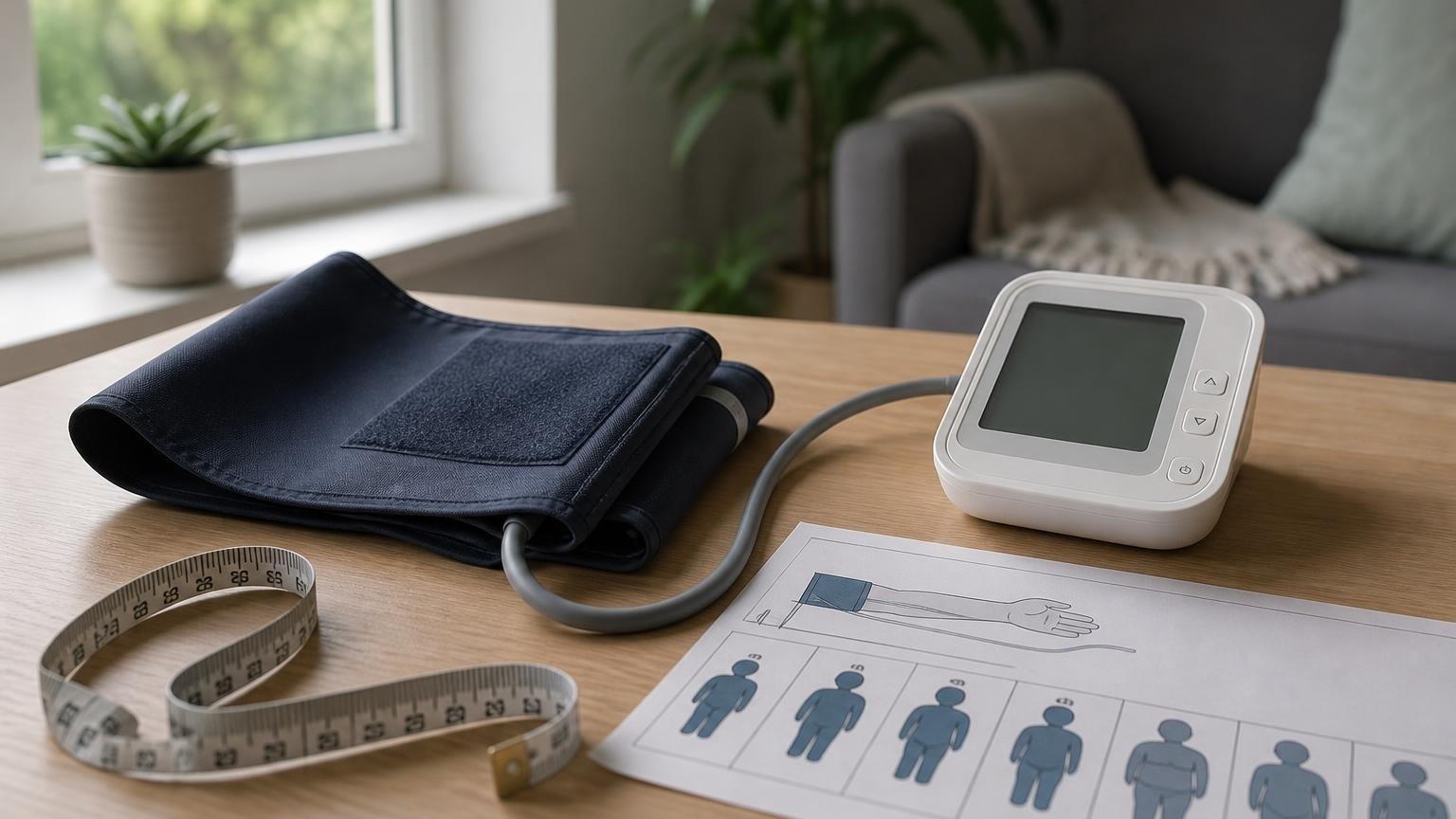
The shape of your upper arm can also make a straight cuff harder to wrap smoothly. Do not solve that by forcing a cuff outside its printed range. Check the manual for the cuff styles and sizes approved for the exact monitor model.
What to do when the cuff balloons or twists
Use one careful reset rather than repeatedly pressing start.
- Stop the measurement. Press the normal stop or start/stop control. If the cuff does not release, follow the emergency-removal instructions in the model’s manual.
- Wait until the cuff is completely soft. Do not tug the tubing or force the air connector while the system is pressurized.
- Remove the cuff and inspect your arm. Persistent severe pain, marked swelling, numbness, weakness, or unusual color after removal deserves medical attention rather than another test.
- Lay the cuff flat. Look for folds, a rolled edge, twisted fabric, a bunched section, separated seams, or a closure that no longer grips normally.
- Inspect the air path. Check the full tube for sharp bends, flattened areas, cracks, stretching, and a loose connection at either end.
- Confirm the cuff range and part number. Measure your bare upper-arm circumference and compare it with the range printed on the cuff or listed in the manual.
- Rewrap only if the parts look sound and compatible. Put the cuff on bare skin, keep it flat and evenly snug, align its artery marker or tube as instructed, and support the arm around heart level.
- Watch the next cycle. Stop using the setup if the same bulge, twist, opening, pain, error, or abnormal inflation returns.
Our blood pressure cuff placement guide shows how to position the cuff above the elbow and align its marker without folds. If the cuff slides down or rotates as pressure builds, use the separate guide to a blood pressure cuff that keeps slipping.
Is some cuff bulging normal during inflation?
A little change in shape can be normal. The bladder is filling inside a flexible fabric sleeve around an arm that is not a perfect cylinder. Cuff designs also differ, so the exact appearance of one model may not match another.
Judge the whole cycle rather than one small crease. A normal cycle should generally have these features:
- the cuff stays secured in its intended position
- pressure builds without a dramatic localized balloon
- the tube remains connected and unkinked
- the monitor releases pressure normally
- no sharp pain, persistent numbness, or significant discoloration occurs
- the device completes the measurement without a cuff or inflation error
Stop and investigate when a section expands far more than the rest, the cuff rolls into a narrow band, the fastener peels open, the bladder seems folded, or the problem appears repeatedly after careful wrapping. Your manual is the authority for what the manufacturer considers normal for that cuff.
Can uneven inflation affect the reading?
It can make the reading less trustworthy, but you should not assume a predictable high or low error. A twisted, slipping, damaged, or badly fitted cuff may change pressure application, interfere with the signal, trigger reinflation, or end in an error rather than produce a consistent bias.
Treat a visibly abnormal cycle as a questionable measurement. If the monitor displayed an error or never finished, do not record it as a completed blood pressure result. If numbers appeared despite obvious cuff movement or ballooning, keep them only with a note about what happened and repeat later with a sound setup.
Do not invent a correction, average an obviously failed reading into your routine log, or change medication because of one number from an abnormal cycle. The AHA’s home blood pressure monitoring guidance recommends a validated automatic upper-arm device, a correctly fitting cuff, quiet rest, supported posture, and repeat readings.
When to replace the cuff or contact the manufacturer
A setup correction may be enough when the cuff was simply loose, folded, or placed over clothing. Replacement or manufacturer support makes more sense when:
- the cuff repeatedly balloons or twists despite a smooth wrap
- the bladder feels bunched and the manual does not provide a user adjustment
- seams are separating or the fabric is stretched
- the closure opens during inflation
- the tube or connector is cracked, loose, or pulling away
- inflation and cuff errors continue with fresh power and correct technique
- the cuff is outside your arm-size range
- the cuff part number is not approved for the monitor
- the monitor was dropped, exposed to liquid, or began behaving differently
Do not unzip, cut, tape, glue, or puncture the cuff. Do not inflate it by mouth or attach it to a different pump. A household patch may hold briefly without restoring the controlled pressure behavior the monitor needs.
If the old cuff is damaged, use our guide to choosing a compatible replacement blood pressure cuff. When the cuff softens unexpectedly or the pump cannot maintain pressure, check the more specific signs of a leaking blood pressure cuff.
If the complete setup remains questionable, contact the manufacturer with the monitor model, serial number, cuff part number, error message, and a description of when the uneven inflation began. A clinician may also decide to observe your technique and use a structured office comparison. The American Medical Association’s Target: BP device accuracy test is designed for trained clinical use; one back-to-back reading on two home monitors is not a calibration test.
FAQ
Q: Why does my blood pressure cuff balloon in one spot?
A: The cuff may be loose, folded, twisted, the wrong size, worn, or damaged. Stop the cycle if the ballooning is marked or uncomfortable, let the cuff deflate, and inspect the wrap, bladder area, seams, fastener, tube, and model compatibility before another reading.
Q: Can I straighten a blood pressure cuff while it is inflating?
A: No. Stop the measurement and wait until the cuff is completely soft before repositioning it. Pulling, rotating, or opening a pressurized cuff can cause pain and does not preserve the reading.
Q: Is an unevenly inflated cuff reading accurate?
A: Do not rely on a reading from a cuff that visibly twisted, slipped, opened, ballooned sharply, or produced an error. Repeat later only after correcting the setup or replacing a damaged compatible part. Do not apply your own numerical correction.
Q: Does an uneven cuff mean the monitor is broken?
A: Not always. A loose or folded wrap, clothing, and the wrong cuff size can cause uneven inflation. Suspect worn or damaged parts when the problem returns after careful setup, or when seams, tubing, the connector, or fastening material are visibly abnormal.
Bottom line
A blood pressure cuff that inflates unevenly needs a setup and equipment check, not a tighter pull while it is pressurized. Stop the cycle, flatten and rewrap the cuff on bare skin, confirm the size and part number, inspect the tube and closure, and watch one careful repeat. Repeated ballooning, twisting, pain, damage, or errors calls for a compatible replacement or manufacturer support.
If the cuff and monitor no longer work as a dependable matched system, compare upper-arm options by validation, cuff range, replacement-part support, and everyday usability:
This article is educational and not medical advice. Consult a qualified clinician before making treatment decisions or changing medication based on home blood pressure readings.
Top 5 picks
Best Blood Pressure Monitors For Seniors 2026
Five upper-arm monitors ranked with published scorecards—setup friction, comfort, readability, power convenience, and repeatable accuracy—so you can compare models before you buy.
See our Top 5 blood pressure monitor picksHome-monitoring advice is only useful if it is easy to verify and act on correctly.
We write explainers to be understandable to readers, search engines, and AI answer systems.
Compare our Top 5 blood pressure monitor picks for 2026, then track readings over time with consistent technique.